On the way home from school, Grace and I discussed what life is. First, Grace said, life needs WATER. Dried things have no life in there, and we discussed eating, pooping and peeing – METABOLISM. Life needs metabolism for ENERGY.
The discussion has been continued, and today during the mother’s day dinner time, we added TEMPERATURE. Corpses have no body temperature she said. Finally, her dad, my hus added SPIRIT, and then,
What else? Grace tried to add OXYGEN, but we did not agree on it, because humans need OXYGEN, but not for all living things.
On this question of “What is life”, I felt that it is very interesting. We could think of the simple question in the view of everything from tiny unicells such as bacteria to the bigger organisms like humans and even the universe. I thought about himan vital signs such as breathing and blood pressure as well.
Suddenly, i murmured the unscientific idea that all things have life because they have birth and extinction.
I finally took a long solo trip. It’s been a really long time since I’ve taken a long solo trip. It’s been 28 years since I went backpacking through Russia and Eastern Europe for four weeks in the summer of 1996. It was a time to look back on my life, which has been so busy running forward, and to reflect on what is truly important in my life. In 1996, when I was in my 20s, I traveled while intensely contemplating questions like —“Who am I?”, “What is the purpose of life?”, “How should a person live to live a meaningful life?”— about the cycle of human birth, aging, illness, and death, and joys and sorrows. Now this recent trip was a time to look back on the past 30 years of my life and make a new commitment to how I live more meaningfully in the next 30 years.
This June, my son graduated from college, and I wanted to treat myself to a vacation after working so hard. I wanted to go to a new place where I did not know anyone for a month or so, do whatever I wanted to do, and relax. While thinking about learning to surf during my vacation, I searched Google to find good surfing resorts in nearby South America and came across a city called Huanchaco in Peru. It was a beautiful small beach town famous for surfing, and it reminded me of a dream I had since my 20s of going to Machu Picchu in Peru, so I decided to make Machu Picchu my destination.
In early July, I arrived in Cusco, the ancient capital of the Inca civilization, and the five-day hike to Machu Picchu was a new challenge for me. I chose the difficult route of climbing Machu Picchu, instead of the convenient bus ride. The physical burden of climbing the steep mountain path was not easy because it was at high altitude. This trip was a journey that challenged the limits of my physical strength, with me struggling to catch my breath.
The first day of the hike was so hard that I thought about giving up, regretting why I even took on this challenge at the age of 50. When I arrived at the campsite at close to 7 pm after walking 22 km (14 miles) from dawn, I didn’t even want to eat dinner because of the pain from head to toe, and I was worried about how I would walk again the next day with this tired body. But strangely enough, when morning came, my body had recovered from a sound night’s sleep, and the pain was gone, and I felt a sense of accomplishment and confidence for having completed the hardest course of the 5-day itinerary.
At that moment, the thought suddenly crossed my mind that our lives are the same. We solve the difficult tasks that life throws at us one by one, and there may be days when we feel so hard that we want to give up, but if we live each day diligently, take on new challenges, and overcome difficulties, we gain a sense of accomplishment and confidence in life, and we find the meaning of life.
Life is a journey, and no one can avoid death. All living beings are born, grow, and mature, and when the time given to them ends, we all return to the embrace of the universe. The moment humans realize that the time given to us is not infinite, we begin to reflect on what is truly important in life.
We may have been living only in pursuit of material wealth and fame, forgetting the meaning of life and what is truly important to us. I looked back on the path I took while climbing the steep road of the mountain. The time of self-reflection in Peru, where I went into my own time and looked inside myself, was a valuable time that made my soul mature one step further. Confucius said that at the age of 50, one reaches a state of understanding the will of heaven. It is an age where one begins to accept life as it is, acknowledging one’s imperfections and embracing destiny. At this age, it’s ok to live authentically, just as I am.
Life is not a race, but a journey.
Hiking Machu Picchu has been on my bucket list for a long time. There are two hiking courses from Cusco to Machu Picchu, the capital of the Inca civilization: the Inca Trail and the Salkantay Trek. There is also a course that takes only two days by bus and train, but what I wanted to do was hike. The Inca Trail has a limited number of tourists per day, so I had to make a reservation at least 3 months in advance. This time, I decided to go on the Salkantay Trek, where I could enjoy more of the natural scenery. I booked a guided hiking tour with a company called Alpaca Tours and arrived in Cusco on July 2nd. I took a break and toured the city to get used to the highlands.
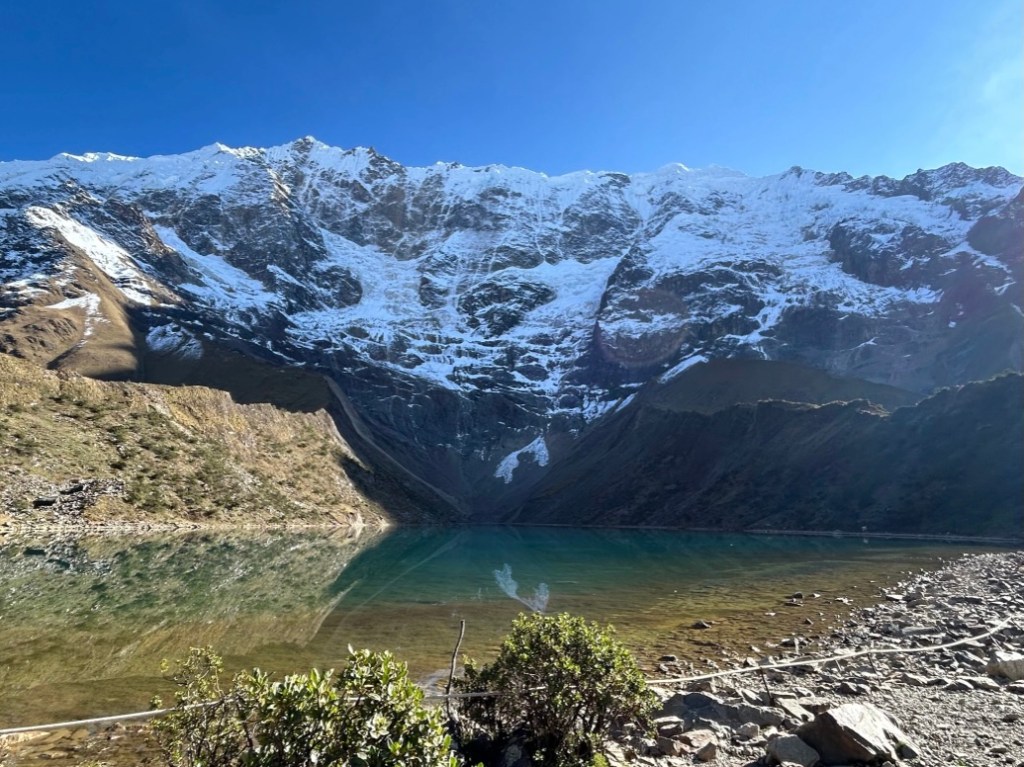
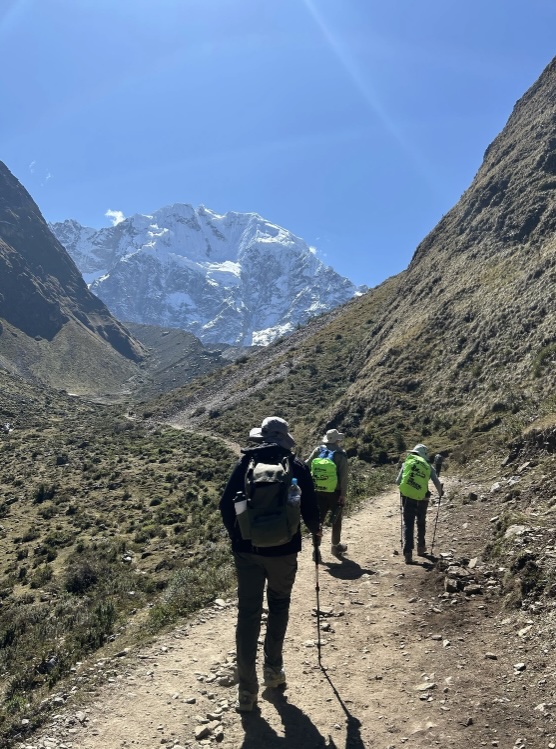
On July 4th, the first day of hiking, at 6 am, we started from the town of Soraypampa, located at 3900 meters above sea level, and climbed up and down to the 4200-meter Human Thai Lake for 2 hours, then walked up a steep trail to the Salkantay Pass, located at 4600 meters above sea level. It was a total course of 22 km (14 miles). The first day of this hike, with snow-covered icebergs in the background, was a day of challenging my physical strength due to low oxygen and steep mountain paths. As I climbed the mountain from dawn, I stopped every few minutes to catch my breath, and I felt like giving up, but I was determined to complete this challenge. Seeing me struggling, Americo, a tour guide, kept telling me, “It’s not a race. Go at your own pace.” Those words somehow encouraged and helped me to climb up one step at a time.
Just like mountain climbing, life is not a race but a journey. Everyone has their own path and journey. Don’t be discouraged or give up because you think you’re falling behind others. If there’s something you want to challenge yourself with, don’t be concerned about what others think or about your age, and try taking action. I remember a conversation with my friend Bill, who works in the same financial consulting field as me. One day, a client named J, who was 60 years old, came to him with a slightly worried face and asked if it would be financially possible for her to go to law school. She had been saving up her money well and managing it wisely, and when he calculated the scenarios and told her that it would be possible, J’s face brightened and she said, “But my son was against the idea and said this.” , “Mom, you’ll be 63 when you finish law school. Why do you want to do it now?”, So J said. “Son, even if I don’t go to law school, in 3 years I will be 63 years old. I want to be 63 years old while doing what I have been dreaming and wanting to do.” If there is something you want to do now but you are hesitating because of your age or the others’ opinions, what about dreaming again and making a plan? Whether it is a hobby or a new career, take the leap. When you challenge yourself with new things, overcome difficulties, and focus on today, you cultivate the garden of your body and mind, enriching your life.
About Michelle Cho, CFP, BFA, ChSNC
She graduated from UCSD with a degree in physics and studied high-energy physics at Cornell University for two years before changing her career. Now she runs a financial consulting firm called Echo Wealth Partners. She is a Certified Financial Planner, Behavioral Financial Advisor, and Chartered Special Needs Consultant and helps clients set financial goals based on their values and provides financial planning and overall investment management services. The goal of the company is to help clients improve their quality of life and live a rich and meaningful life through smart financial management and planning.
More than 100 people after using a drug – Elixir Sulfanilamide, died.
Sulfanilamide, a drug used to treat streptococcal infections with dramatic curative effects, and safely used in tablet and powder form. In June 1937, S.E. Massengill Co., in Bristol, Tenn., manufactured the drug in liquid form with diethylene glycol. No toxicity and pharmacological studies had been done on the new sulfanilamide preparation. Diethylene glycol (antifreeze) is a deadly poison.
On Oct 11, 1937, the American Medical Association (AMA) received incidental report from physician in Tulsa, Oklahoma, that an unfamiliar sulfanilamide compound was responsible for a number of deaths, and AMA laboratory isolated diethylene glycol as the toxic ingredient and immediately issued a warning through newspapers, and radio that Exlixir Sulfanilamide was toxic.
Next year 1938, FDA set out to make sure all of the drug was retrieved. 239 FDA inspectors and chemists was assigned to the task, and state and local health officials joined the search, and newspapers and radio stations continued to issue warnings.
Chaos
In some drug stores, the elixir had been sold without prescriptions to purchasers whose names the druggiest did not know. In other cases, doctors had incomplete records, or none at all- of the names and address of patients for whom they had prescribed. Even one East St. Louise woman told an inspector she had destroyed the drug. The inspector persisted in his questions how did she destroy. Her answer was that she had thrown the bottle out the window into an alley. The inspector found the bottle still unbroken, still containing enough elixir to kill any child.
A South Carolina doctor told an inspector that he had dispensed the medicine, but none had died, but the inspector found all his patients had died after taking the elixir.
Of 240 gallons manufactured and distributed, 234 gallons and 1 pint was retried.
Victims
Many of them were kids, treated for sore throats. All exhibited similar characteristic of failed kidney, stoppage of urine, abdominal pain, nausea, vomitting, stupor, convulsions.
However, the firm was not illegal, because in 1937, the law did not prohibit the sale of dangerous, untested, or poisonous dugs. Dr. Samual Evans Massengill, the firm’s owner said: My chemists and I deeply regret the fatal results, but there was no error in the manufacture of the product. We have been supplying a legitimate professional demand and not once could have foreseen the unlooked-for results. I do not feel that there was any responsibility on our part.” The Chief Chemist, Harold Watkins committed suicide after learning of the effects of his latest concoction.
1938 Federal Food, Drug and Cosmetic Act
FDA Commissioner Walter Campbell pressed for better federal regulation of drugs, and pointed out how the inadequacy of the law had contributed to the disaster.
The Elixir disaster hastened enactment of the 1938 Federal Food, Drug, and Cosmetic Act. New Drug section, added to prevent such tragedies, gave the US a new system of drug control which provided superior protection and 25 years later, this Act saved the Nation from an even greater global drug tragedy— a thalidomide disaster
In the 1938 Food, Drug, and Cosmetic Act, requires perform animal safety tests.
However, currently, that requirement, especially cosmetics is not mandatory, if the company provides an evidence of the safety
Reference: Carol Ballentine, FDA consumer magazine, June 1981 Issue
June 15 2024, The original writing was written in my wonderful English class (EngL100) at MiraCosta college.
Prologue
I was a little hesitant about which texts to choose between Reflections of a 17-year-old by Sylvia Plath (excerpt from journal) and A Hard Rain’s Gonna Fall by Bob Dylan (song). Regardless of the warning not to choose A Hard Rain’s Gonna Fall if you do not have enough knowledge of music composition and terminology, I could not avoid choosing A Hard Rain’s A-Gonna Fall for my choice to analyze it when I listened to the music piece. I definitely heard the name of Bob Dylan, but I never knew the details about him, or heard any of his music pieces so far. However, I felt I knew his melody when I listened to it. The first feeling of the song A Hard Rain’s Gonna Fall was warning, gloomy, and even horrible. The music raised me the images of the animation, Princess Monnonoke. Princess Monnonoke is a 1997 Japanese film.
Introduction
Bob Dylan who composed a Hard Rains a-Gonna Fall is an American singer and songwriter. He is one of the best-selling musicians and a Nobel Prize winner in literature. His first debut album, The Freewheelin’ Bob Dylan (1963), was a big hit, and he (age 83) is still running a music festival tour (Wiki). The topic and motif of his rock and roll’s lyrics in his songs are understood as part of the Civil Rights Movement. A Hard Rain’s A-Gonna Fall was written in 1962 and recorded in 1963 (Wiki) when his age was 21 and 22. The themes of the song are series of images as arranged: dead forests and oceans (environment, pollution), orphanages, no people, no communication, a lost innocent and conscientious young generation, a destroyed blue-eyes’ world, no attention to others, individualism, hatred and a warning to escape or fight against these coming hard rains. However, these themes have values in all ages even of Noah’s time and even today. The year 1960s , when this song released, summarized as the most tumultuous and divisive decade in world history, marked by the civil rights movement, the Vietnam War and antiwar protests, countercultural movements, political and generation gaps, and the lyric of the song encapsulates the view of the times. The lyrics of the song are a part of his society, America and world young generation of 1960s as much as his personal growth development.
The lyrics of A Hard Rain’s A-Gonna Fall
1 Oh, where have you been, my blue-eyed son? 2 And where have you been, my darling young one?
3 I’ve stumbled on the side of twelve misty mountains, 4 I’ve walked and I’ve crawled on six crooked highways, 5 I’ve stepped in the middle of seven sad forests, 6 I’ve been out in front of a dozen dead oceans, 7 I’ve been ten thousand miles in the mouth of a graveyard. 8 And it’s a hard, it’s a hard, it’s a hard, it’s a hard rain’s a-gonna fall.
9 Oh, what did you see, my blue eyed son? 10 Oh, what did you see, my darling young one?
11 I saw a new born baby with wild wolves all around it, 12 I saw a highway of diamonds with nobody on it, 13 I saw a black branch with blood that kept dripping,
14 I saw a room full of men with their hammers a-bleeding, 15 I saw a white ladder all covered with water, 16 I saw ten thousand talkers whose tongues were all broken, 17 I saw guns and sharp swords in the hands of young children. 18 And it’s a hard, it’s a hard, it’s a hard, it’s a hard rain’s a-gonna fall.
19 And what did you hear, my blue eyed son? 20 And what did you hear, my darling young one?
21 I heard the sound of a thunder, it roared out a warning, 22 Heard the roar of a wave that could drown the whole world, 23 Heard one hundred drummers whose hands were a-blazing, 24 Heard ten thousand whispering and nobody listening, 25 Heard one person starve, I heard many people laughing, 26 Heard the song of a poet who died in the gutter, 27 Heard the sound of a clown who cried in the alley, 28 And it’s a hard, it’s a hard, it’s a hard, it’s a hard rain’s a-gonna fall.
29 And who did you meet, my blue eyed son? 30 And who did you meet, my darling young one?
31 I met a young child beside a dead pony, 32 I met a white man, who walked a black dog, 33 I met a woman, whose body was burning, 34 I met a young girl; she gave me a rainbow, 35 I met one man, who was wounded in love, 36 I met another man, who was wounded with hatred. 37 And it’s a hard, it’s a hard, it’s a hard, it’s a hard rain’s a-gonna fall.
38 Oh, what’ll you do now, my blue eyed son? 39 Oh, what’ll you do now, my darling young one?
40 I’m going back out ‘fore the rain starts a-falling, 41 I’ll walk to the depth of the deepest black forest, 42 Where the people are many and their hands are all empty, 43 Where the pellets of poison are flooding their waters, 44 Where the home in the valley meets the damp dirty prison, 45 Where the executioner’s face is always well hidden, 46 Where hunger is ugly, where souls are forgotten, 47 Where black is the color, where none is the number, 48 And I’ll tell it and think it and speak it and breath it, 49 Then I’ll stand on the ocean until I start sinking, 50 But I’ll know my song well before I start singing, 51 And it’s a hard, it’s a hard, it’s a hard, it’s a hard rain’s a-gonna fall.
The subject of this song, who is, was, or will be responsible for or in charge of this gloomy and unsatisfied world, is “blue-eyed son”. Blue-eyed son means the American White young healthy generation or Bob Dylon himself. This song is asking for the current or future responsibility of the blue-eyed son to avoid or fight against the coming hard rains. Hard rains are catastrophe like the Great Flood, a kind of God’s punishment
Let’s move and see the repeated below lyrics in this song. The current chaotic world was caused by the absence of the blue-eyed son (young, healthy white responsible generation) or his darling young generation, and this song is asking them/blue-eyed son/daring young generation to see the current political chaos, hatred, industrialization, and deprived environment, and this song is again asking or even encouraging the young generation’s proper or right action to escape the bigger catastrophe.
Oh, where have you been, my blue-eyed son?
Oh, where have you been, my darling young one?
Oh, whatdid you see, my blue-eyed son?
Oh, what did you see, my darling young one?
And whatdid you hear, my blue-eyed son?
And what did you hear, my darling young one?
Oh, who did you meet, my blue-eyed son?
Who did you meet, my darling young one?
Oh, what’ll you do now, my blue-eyed son?
Oh, what’ll you do now, my darling young one?
Let’s check another repetition of phrases after different part of lyrics below. This is Emphasis and Soliloquy of this poem. The expression in this short-repeated phrases, has Symbolism, Tone, Mood, Satire, Imagery and Colloquialism in techniques.
And it’s a hard, and it’s a hard, it’s a hard, and it’s a hard
And it’s a hard rain’s a-gonna fall
In the phrase, it’s hard is repeated again, emphasizing that the coming rain is greatly hard and destroying. A hard rain is like the Great rain that sins the whole world.
Let’s move on the other parts of the lyrics. The other parts have Irony, Metonym and Synecdoche as well as techniques of Soliloquy, Symbolism, Tone, Mood, Satire, Imagery and Colloquialism. The first part (lines 3-7 indicated above) of the song describes a sad and deadly world: twelve misty mountains, six crooked highways, seven sad forests, dozen dead oceans, and ten thousand miles in the mouth of a graveyard. What numbers (12, 6 and 7) means? Bob Dylan surely has the exact meaning of the numbers although others are not easy to know. The number 12 is our world of mountains and oceans that are misty and dead. The number 6 is men-made roads that are crooked. The number 7 is the forest that is sad. What 7 forests mean exactly. 7 continents or 7 kings. 7 seems be somehow 7 authorities located or connected between crooked highways (men) and mountains and oceans (world). The second part (lines 11-17) describes: new bone baby, new young generation is around wild wolves, describing “threatened by the old generation, notion, environment, politics etc”. The wild wolves might mean the old generation, notion, environmental deprivation, political injustice. There is another highway of diamond, where nobody is, and while latter maybe from the dead ocean, but covered. Dead forest continues described as blood dripping branches that men made. The men want to talk but the talkers could not talk because they do not have tongues. Young children have guns and swords, marching toward graveyards. Words of diamonds, hammers-a-bleeding, white ladder, tongues, guns, sword, hands, young children are Symbolism and Synecdoche. The most of these words transfer horrible mood but diamonds and white ladder are hints of hopes that this destroying world has inside, even although they are invisible and covered. The third part (lines 21-27) of the song is a kind of warning, but nobody could listen to or notice the warning, because they could not even hear others near them. Poets died and clowns cried. Many people laughing and one person starves. The fourth part (lines 31-36) described broken hearted individuals: young child with dead pony, white man with black dog, burning women. They are all like ghosts and wounded. but there is still hope described as a rainbow that a young girl has. The last part (lines 40-50) is resolution and shouting, even losing the war to fight against hard rains. This is a declaration against the older or existent generation or even himself, or he is still outside the his life and real world, showing his resolution that Bob Dylon wants to walk into dark black forest, even he wants to go deep into the black darkness with his free will or warm heart, but he wishes he would go back out of the forest before the rain. Let’s see the bellowed lyrics. The lyrics is beautiful sounding of soul full of resolution and confidence.
And I’ll tell it and think it and speak it and breathe it
And reflect it from the mountain so all souls can see it
Then I’ll stand on the ocean until I start sinkin’
But I’ll know my song well before I start singin’
In summary, this is a sad song of accusation, warning, and declaration, but it calls for the hope of a rainbow. This lyrics is sad but not weak, and sounds strong and full of confidence, showing resolution against the world around him.
by Handaesu ((lyric is different, but sounding is similar to the song A Hard Rain’s A Gonna Fall), more songs by Minki Kim (who is recognized as a Korean Bob Dylan), and Taechun Jeong. All of these songs are beautiful, and evoke lingering emotions from our hearts and ask for a kind of justice and community happiness, although the melody is simple and repetitive. Furthermore, these songs represent a kind of young generation, development or growth from kids to the adults, start seeing or realizing the imperfect world around themselves.
July 11 2024, The original writing was written in my wonderful English class at MiraCosta college.
Religious education requirement in the USA and current situation of Disney films as an instrument of intercultural moral and spiritual education
SooYoung Kim
This essay is personal opinion and not based on research and expertise views.
America is one of the countries that empathize cultural and individual diversities, However, America is a Christian country, so America has a kind of paradoxical situation between religious uniformity and cultural diversity. Paradoxically, there is no religious diversity in the USA, with a percentage of over 58% Christianity although the immigrants are from all other different countries. The cultural and sociological systems do not support any religious activities, and school system has no religion education. According to the first Amendment to the United States Constitution, freedom of religion is guaranteed, and the school system is separated from any religion education and practices. It is believed or considered that religion is a personal one and should be taken from family. There are many immigrants from all over the world coming to the USA. When they step into the USA, they easily adapt to the USA religious uniformity and start attending Christian Church, maybe due to the convenience of easy-to-find Christian churches, and obtain support from them or teach any kind of religion to their next generation easily, not insisting on the old religion practice. Thus, despite of the diverse immigrants the USA is still a region of uniform Christianity.
There is a kind of opposite society where there are almost no immigrants, but quite a diverse and dynamic religion mixture. Korea has passed Shamanism over 4,000 years and Buddhism over 2,500 years, and the Last Kingdom Joseon dynasty was established with Confucianism as a moral system. During the late Joseon dynasty, Christianity was imported to Korea, and currently Christianity has become a dominant religion type in South Korea. But South Korea sociology allows religious internal, social, cultural, inter-family diversity and freedom, and they are tolerating to any religion. However, Christianity in South Korea might be different from any other countries because Christianity in South Korea could be a mixture with other religion backgrounds, such as Buddhism and a moral system, Confucianism. It is meant that religion is not separated from society and any religions keeps changing with peoples. Furthermore, there are similarity between Christianity and traditional morality of Korea: Men lead families, wives serve husband’s leadership, and kids obey to their parents. The similarity is one reason that peoples was easy to change their religions.
There are crisis and big problems in the current USA educational system, because the most families in the USA do not transfer any religious practice to their next generation, losing their function, and the next generation could not have any religious experiences. Most children do not adhere to any specific religious beliefs that are exemplified by their parents. Religious practices and learning are part of moral education and the deepest roots of harmony with oneself and others. Many Asian countries have moral classes, and the UK included religion education in the 1988 Education Reform Act to reflect the multiculturalist policy. It has taught big six religions-Christianity, Judaism, Islam, Hinduism, Sikhism and Buddhism- but is currently expanding to teach more diverse world religions, and at the same time non-religion, and other moral philosophies that are sociological structure (Shaw). Some countries are more easily accessible to different religious services with friends, and even kid alone, but in the USA, if parents reject attending any religious community, the children are very unlikely to be exposed to any religious system. The educational system does not need to teach religious practice and faith but could teach religious core and historical and broad common views of religion, nurture moral and spiritual sense, and promote religious diversity as well as cultural diversity. There are some comments from UK pupil and teachers for the need of religion education (Shaw).
“We live in a country with loads of different religions and I think we should learn about each different one, so if you do come across them, you know what they’re on about, and you know who they are” (Pupil)
“Obviously you cannot look at them all, but I think it’s important to look at how people have beliefs but they may not be within a formal religion” (Parent)
“I think they (non-religious worldviews) are just as important to learn as like Christianity because it’s still a form of belief” (Pupil)
“I’d want them [pupil] to think more broadly about what we class as religion too. There are people that dance round Stonebenge naked because the sun’s up. Does that fall under the remit? Definitely it does of spirituality.” (Teacher)
“I think religion lives and breathes, it’s the same with language, it’s eternally changing. We should teach it as that” (Teacher)
“We need to learn about how religion mixes into politics” (Pupil)
The above article shows the learners’ desire for learning about a broader range of religions and an understanding of religion, belief, and interrelationship with society. This is UK schools’ example, but it would be not quite different in other countries. Even atheists would want to learn about more religion. Even If there is a desire to know all kinds of religion, it is not easy for one person to learn and understand even one kind of religion. Thus is another reason for us to give religion education in the school system. Also, there are core similarities among religions and differences that have aroused wars and even current. As global citizens, the next generation need to be prepared for global diversity including religion.
In the USA, Disney film play a role to teach religion core, spirituality and engaging kids to learn morality. Kids have natural empathy, imagination, and natural animisms to give life to non-alive items (Wonderly). The kids’ spirituality might be something important located before any religion system, and Disney is teaching such spirituality via kids’ animation. The first generation of Disney animation, such as Snow White, Cinderella, and Sleeping Beauty, does not, but Disney animation started to adapt or generate the USA or global common shared spiritual mindsets regardless that they have different religions and no religion at all. See Disney animation of Mulan, Pocahontas, Ariel of The Little Mermaid, Beauty and beast, Moana, Frozen, Elements and If. Although Disney provides common spiritual moral learning and film is a great tool for an educational tool (Wonderly), it has limitation and could not teach exact meaning and could be mis-conceptualized, it might be the proper time that the school system in the USA provides religion diversity education, global religion view, and political understanding of religion as well as core religious spirituality.
Reference
Shaw, Martha, “New Representations of Religion and Belief in Schools”, Religions 2018, 9, 364, https://doi.org/10.3390/rel9110364
Wonderly, Monique, “Children’s Film as an Instrument of Moral Education”, Journal of Moral Education, 2009, 38, 1, 1-15
I enrolled in one English Class at MiraCosta College, California, in the USA, for the first time in my life. My teachers’ name is Donna Fazio DiBenedetto. I just had 2 units, but I feel already, I am learning quite a good quality of English reading and writing class. Last week, we read “In Los Angeles, a Garden Oasis.” Written by Stella Kalinina, and we wrote our essays.
“In Los Angeles, a Garden Oasis is “a physical and spiritual recovery zone, a cooperative and multi-cultural zone, and the Garden Oasis connects humans to humans, community, generations, and nature.” While reading, I think hard about where my comfort zone and my soul nourishment oasis are. Here California has community gardens all around, and when we visit the library, we can easily get the information. The below is my assay which I wrote for the class but a little bit modified for my blog.
So far, my physical and spiritual recovery and conforming zone is in my hometown, where I grew up. To say more specifically, my oasis is my mother’s food, my parents’ garden, and their support. When I need help, I visit them, and I recover physically and spiritually.
I grew up in a small city named Chuncheon in South Korea. Chuncheon has rivers, ponds, and mountains all around. My parents have a large garden that has fine trees, flowers, and fruit trees. Almost all the trees are older than me because my dad planted most of them with his dad, my grandfather. I had a rabbit, chickens, and dogs when I was young in the garden. My parents sometimes planted peppers, eggplants, lettuces, and peas. Among my three siblings, I was the best garden lover and helped to remove weeds and shape trees. The garden had chives as well, so I could eat chive pancakes at any time.
To study after high school, I moved to Seoul, the biggest city in South Korea where my college was located, and I lived around Korea University from 1994 to 2010, before I came to the USA. I am just realizing that I have not stayed at any one place for over 20 years so far. If I live a long time in one place, my comfort zone might change, but at this moment, my comfort zone is still my hometown. When I had to stop studying at college due to tuberculosis sickness, I returned to Chuncheon. One thing that I enjoyed was harvesting peas and removing weeds while listening to music in the garden. At that time, I liked a song of Squre’s Dream. Another thing I enjoyed was walking outside and riding buses without destinations. When I had my second baby in the USA, I missed my hometown, flowers, and mountains. I missed even the color of the sky that I saw in Korea. Korea has its own plants and flowers such as Jindallae (Korean rosebay), Gaenali (forsythia), and Cosmos (kosmea), and a clean blue sky in autumn like here in California. California has the same type of Cosmos flowers as those found in Korea, but it was hard for me to see Cosmos flowers when I lived in Maryland, Eastern USA. When I heard a music piece named Spring in My Hometown, Gohyang-uibom, I was gloomy, sad and teary. My husband and I wanted to save money and did not often visit Korea. Actually, we had not visited Korea for 7 years straight. When I quit working my second job in the USA, I finally visited Korea with my two daughters, and I regretted that I should have visited my parents more often. None of us can catch or stop time. Our parents will not wait for us forever if we do not visit them. During the COVID pandemics from 2020 to 2021, I stayed in Korea with my second daughter, helping my parents, while still working for a living for my family and them, which was hard but gave me infinite strength. After COVID, my family moved to California from Maryland because my husband and I had new jobs here. However, a job at a small biotech company was not stable, and when the company closed my center, I lost my job. This time, I do not feel weak, but I feel that I have to visit my hometown and see my parents, and others.
Now, I know my physical and spiritual Oasis is still my parents, my old home where I grew up, but somehow, I feel I started having another Oasis here in California. I dream of staying at one place, in California for a long time, and feel that my family is another of my Oasis.
Today, I hope to mention cultural differences in death in Korea and the US. I do not say there are differences between Asia and Western because I do not want to generalize too much, and I do not know about any other countries.
There were several differences between funerals in Korea when I was young and Western funerals, but currently, many Koreans have started following the Western style and/or mixed form of them.
To understand funerals and deaths in Korea,
Maybe we should mention the Korean word, 돌아가다 (Die), our Korean word of 돌아가다 (Die) means also “Return”.
So Dying is Returning to original home place, and usually, funeral is a bigger festival than any other souvenir days such as birth and wedding.
In the movie, you could see white Korean dress and a white ribbon hair pin, which relatives and related people wear when someone dies.
Whereas the Westerners wear black.
And the person who died, wore hemp clothes. Hemp is one of the best clothes that returns to the dust and returns to nature.
Sometimes, the elderly and seniors in Korea prepare their own hemp before dying.
Also, direct children, usually men, also wear hemp clothes.
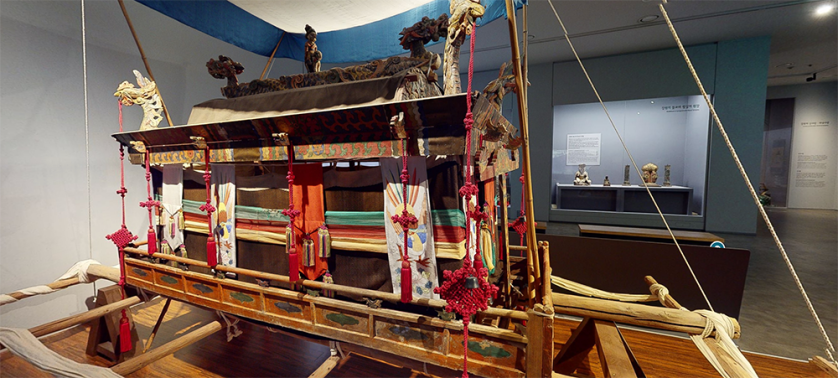
Also, you should understand the splendid, and even gorgeous carrier called 상여 (Sang-yeo) used to move died person from the funeral festival place to the grave site called 장지 (Jangi).
20-30 years ago, when I was a kid, there were a kind of 49, 100 or 150 times praying /ancestral rites to wish that person who died, go to a good place. In that case, every week, relatives gather at some place usually a temple, where sometimes, a monk danced to make a wish to return well together.
I/my generation may be the last generation to see and attend this Korean culture.
Please visit the link if you want to see a monk dancing called Seungmu.
 Life and Biology stories with Sooyoung and Others