[Wine Bits and Sips] The Charm of Wine

I share a series of Wine Bits and Sips, written by Junghyun. We invite you to start your wine journey right here, with us as your friendly guide, Junghyun.

for the original Korean version

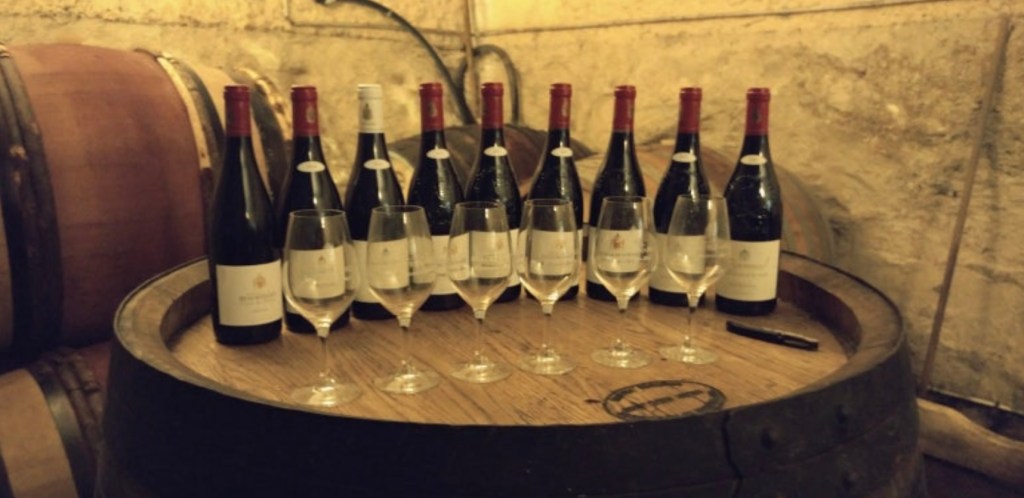
Winery of Chateauneuf du Paoe

Before we dive into wine cellars, ratings, and the age-old debate whether an expensive bottle is truly worth its price, let me tell you why I got into wine in the first place.

The beauty of wine, I think, is this: without packing a bag or going anywhere, you can sit still and travel the world through all five senses. That’s the charm, and sometimes, honestly, it can also be the headache. Choosing a wine can feel like a multiple-choice question with answer options that spill onto the next page. You can’t always get it right. But that’s exactly why the moment you stumble upon something extraordinary feels so electrifying. One unexpected sip can make your eyes go wide in wonder. When a wine truly delights you, even the long hunting for that perfect bottle becomes a kind of play. The risk is, of course, that if you fail too many times in a row, the motivation to keep trying quietly fades away. Along with it, you lose the chance of ever finding that one wine that brings you genuine happiness. This is why, rather than picking at random, it helps to improve your odds a little bit.

That’s what this series is about.

The usual advice is to begin your journey by finding a grape variety you enjoy.

Build a framework, something to anchor your choices so they’re easier to remember. In the New World, many wines are crafted from a single, well-known variety, which makes comparisons much easier. Mid-range American wines in particular tend to express their grape variety in a direct, straightforward way. Trying different bottles from the same producer, such as Long Barn or Textbook, across different varieties is a great way to map out your preferences. Textbook is best known for its reds and produces across a wide range, including Cabernet Sauvignon, Chardonnay, and Sauvignon Blanc, with Pinot Noir being a more recent addition to their lineup. Each grape brings its own skin thickness, natural sugars, and character, and you’ll taste these differences in the glass as distinct wine’s texture, tannins, acidity, and finishes. Once you discover a variety you love, you can begin expanding your horizons by seeking out the same grape from different countries. However, keep in mind that this is only one of many ways to explore the world of wine. 

Wine, they say, is a joint creation of the grape, the terroir, and the winemaker’s human hand. In France, it’s traditional not to list the grape variety on the label. Bordeaux-style blends are common, and the French tend to feel that variety alone doesn’t determine the wine’s soul. They see little reason to highlight it as the primary feature. During a Bordeaux winery tour years ago, where most of the guests were American. The winemaker poured a glass of deep, dark red wine and challenged us to guess the grape. Most guessed Cabernet Sauvignon or Syrah. The answer? 100% Merlot. These graphs came from vines nearly a hundred years old, rooted in the dry, stony soil of a hillside. While we were in Saint-Émilion on the Right Bank, an area where Merlot is the dominant variety and typically blended with small amounts of Cabernet Franc and Cabernet Sauvignon, that tasting was a revelation. It was the exact moment the concept of terroir finally clicked for me, instantly and completely.

I came to wine with a strong conviction that France was its spiritual home of wine, so I started there, tasting my way across the regions one glass at a time. Unlike the New World, France places terroir at the center of everything. I fell for the rich, brooding tannins of Bordeaux reds: that dark tropical fruit, the weight, and a seductive, perfume-like quality that lingers like a single drop of fragrance. A wine with real complexity doesn’t just speak to your palate. It speaks to your imagination. I’d find myself picturing an elegant woman in a field of wildflowers or something bold, dynamic, almost physical. That’s Bordeaux red to me.

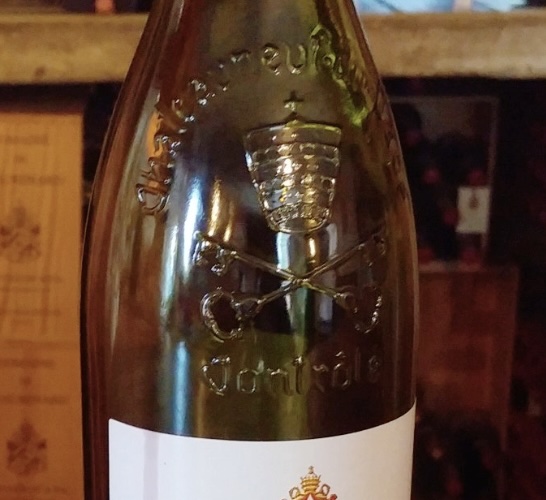
Chataeuneuf du pape bottle

Then came Châteauneuf-du-Pape (CDP), often called the Pope’s wine, hailing from the southern Rhône valley. During the Avignon Papacy, Pope John XXII built a summer residence and a winery north of Avignon, giving the region its name, which translates to the “new castle of the Pope.” While history suggests that the wines of the Rhône still required refinement at the time, leading the Pope to reportedly ship in Burgundy until local quality improved. One of the most striking features of these bottles is the embossed papal coat of arms, featuring the tiara over the keys of Saint Peter, which sets them apart from everything else on the shelf. CDP is a blend led by Grenache, Syrah, and Mourvèdre (GSM), along with other permitted varieties [the list has been revised from 13 down to 9 permitted varieties], which gives it a characteristic complexity. As a wine built for long aging, it possesses both power and elegance that never disappoints. Rich and full-bodied, yet more reasonably priced than Bordeaux or Burgundy, so it’s become my trusted bottle. It is a wine that feels particularly right from late autumn through the Christmas season, offering a warmth from the inside out. The only catch: it’s not exactly an everyday-priced bottle. Though when you see the vineyard, where every grape is hand-harvested and farmed organically, the price starts to feel entirely fair.

One afternoon at Lotte department store wine event, a staff recommendation led me to a Southern French Syrah

Most people associate Syrah with Australia, but it originated in France’s south. Phylloxera (a kind of aphid) devastated the vineyards of the region in the 19th century, and the Syrah planted today is technically a reimported variety; however, something about this land remains unchanged. The combination of limestone and gravel soils, paired with the fierce Mistral wind, gives Southern French Syrah a character entirely unlike its Australian counterpart. I drank a 2012 vintage in 2023 and was struck by the kind of balance and depth that only a well-aged, high-quality wine can offer. That specific wine is no longer imported, but whenever I spot a Syrah from the neighboring Roussillon region, it goes straight into my basket. Roussillon was long known for cheap table wine, but with talented winemakers moving in, the quality has surged, and you now find genuinely excellent value there.

When dining out, I often ask for a wine pairing recommendation, a habit that sometimes leads me to bottles I’d never have chosen for myself.

This is exactly what happened at a wine bar near my home. I typically did not reach for American wines, and when it comes to whites, I rarely stray beyond French Chardonnay, but this was wonderful, offering a rich, almost oily texture and ripe orange fruit, complemented by a touch of oak and just a whisper of mineral on the finish. It was quite simply delicious. Curious to see whether I could find a similar experience elsewhere, I tracked down a South African Chardonnay in the $20 range. South Africa occupies somewhere between the Old World and the New with a wine history that is much longer than most people realize. The Dutch East India Company planted vines there as early as 1662, producing the country’s first wine by 1669. By the 1880s, South Africa had become one of England’s premier wine suppliers until politics, natural disasters, and war pushed it into obscurity for decades. It was only under the presidency of Nelson Mandela that the wine industry began to rebuild. Today, South African winemakers draw from both traditions by studying Burgundian techniques while embracing the expressive, fruit-forward styles of the New World. The result is a collection of wines with a unique identity that often provide exceptional value.

Every new variety, region, and producer weaves together terroir, intention, and craftsmanship into a story that awakens all five senses. The world of wine is truly boundless.

This is how I travel the world, right from the glass on my dinner table.

Discovering ‘Myself’ on the Unknown Road to Machu Picchu

Written by Michell Cho, in 2024

I finally took a long solo trip. It’s been a really long time since I’ve taken a long solo trip. It’s been 28 years since I went backpacking through Russia and Eastern Europe for four weeks in the summer of 1996. It was a time to look back on my life, which has been so busy running forward, and to reflect on what is truly important in my life. In 1996, when I was in my 20s, I traveled while intensely contemplating questions like —“Who am I?”, “What is the purpose of life?”, “How should a person live to live a meaningful life?”— about the cycle of human birth, aging, illness, and death, and joys and sorrows. Now this recent trip was a time to look back on the past 30 years of my life and make a new commitment to how I live more meaningfully in the next 30 years.

This June, my son graduated from college, and I wanted to treat myself to a vacation after working so hard. I wanted to go to a new place where I did not know anyone for a month or so, do whatever I wanted to do, and relax. While thinking about learning to surf during my vacation, I searched Google to find good surfing resorts in nearby South America and came across a city called Huanchaco in Peru. It was a beautiful small beach town famous for surfing, and it reminded me of a dream I had since my 20s of going to Machu Picchu in Peru, so I decided to make Machu Picchu my destination.

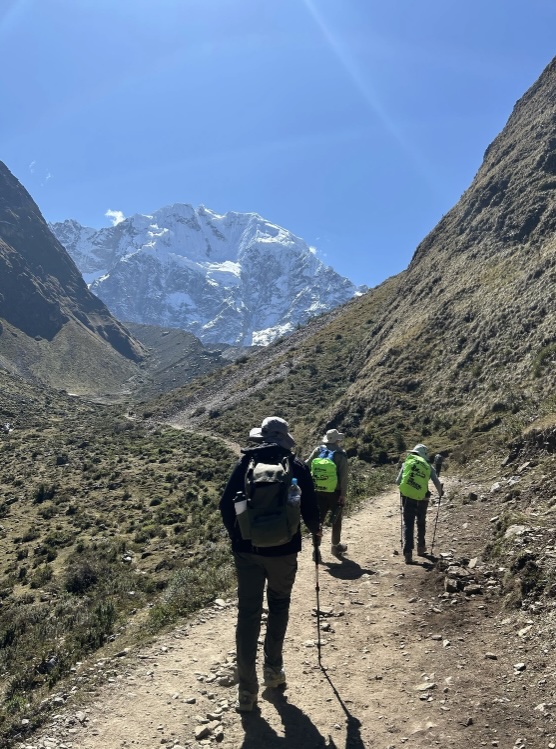
In early July, I arrived in Cusco, the ancient capital of the Inca civilization, and the five-day hike to Machu Picchu was a new challenge for me. I chose the difficult route of climbing Machu Picchu, instead of the convenient bus ride. The physical burden of climbing the steep mountain path was not easy because it was at high altitude. This trip was a journey that challenged the limits of my physical strength, with me struggling to catch my breath.

The first day of the hike was so hard that I thought about giving up, regretting why I even took on this challenge at the age of 50. When I arrived at the campsite at close to 7 pm after walking 22 km (14 miles) from dawn, I didn’t even want to eat dinner because of the pain from head to toe, and I was worried about how I would walk again the next day with this tired body. But strangely enough, when morning came, my body had recovered from a sound night’s sleep, and the pain was gone, and I felt a sense of accomplishment and confidence for having completed the hardest course of the 5-day itinerary.

At that moment, the thought suddenly crossed my mind that our lives are the same. We solve the difficult tasks that life throws at us one by one, and there may be days when we feel so hard that we want to give up, but if we live each day diligently, take on new challenges, and overcome difficulties, we gain a sense of accomplishment and confidence in life, and we find the meaning of life.

Life is a journey, and no one can avoid death. All living beings are born, grow, and mature, and when the time given to them ends, we all return to the embrace of the universe. The moment humans realize that the time given to us is not infinite, we begin to reflect on what is truly important in life.

We may have been living only in pursuit of material wealth and fame, forgetting the meaning of life and what is truly important to us. I looked back on the path I took while climbing the steep road of the mountain. The time of self-reflection in Peru, where I went into my own time and looked inside myself, was a valuable time that made my soul mature one step further. Confucius said that at the age of 50, one reaches a state of understanding the will of heaven. It is an age where one begins to accept life as it is, acknowledging one’s imperfections and embracing destiny. At this age, it’s ok to live authentically, just as I am.

Life is not a race, but a journey.

Hiking Machu Picchu has been on my bucket list for a long time. There are two hiking courses from Cusco to Machu Picchu, the capital of the Inca civilization: the Inca Trail and the Salkantay Trek. There is also a course that takes only two days by bus and train, but what I wanted to do was hike. The Inca Trail has a limited number of tourists per day, so I had to make a reservation at least 3 months in advance. This time, I decided to go on the Salkantay Trek, where I could enjoy more of the natural scenery. I booked a guided hiking tour with a company called Alpaca Tours and arrived in Cusco on July 2nd. I took a break and toured the city to get used to the highlands.

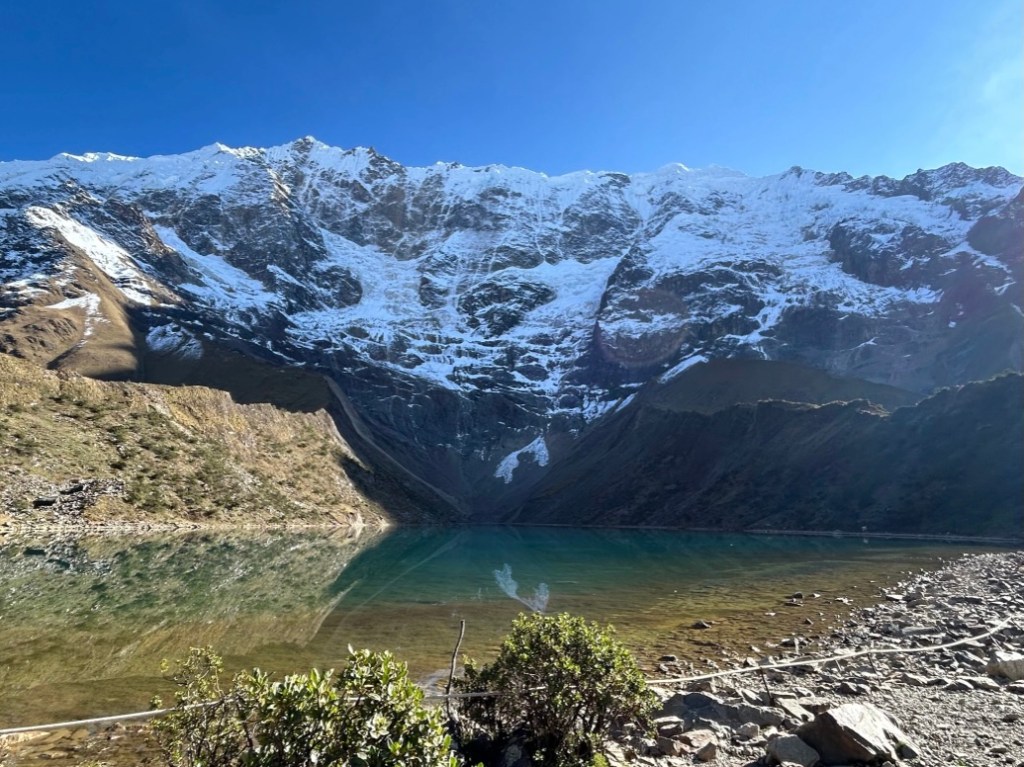
On July 4th, the first day of hiking, at 6 am, we started from the town of Soraypampa, located at 3900 meters above sea level, and climbed up and down to the 4200-meter Human Thai Lake for 2 hours, then walked up a steep trail to the Salkantay Pass, located at 4600 meters above sea level. It was a total course of 22 km (14 miles). The first day of this hike, with snow-covered icebergs in the background, was a day of challenging my physical strength due to low oxygen and steep mountain paths. As I climbed the mountain from dawn, I stopped every few minutes to catch my breath, and I felt like giving up, but I was determined to complete this challenge. Seeing me struggling, Americo, a tour guide, kept telling me, “It’s not a race. Go at your own pace.” Those words somehow encouraged and helped me to climb up one step at a time.

Just like mountain climbing, life is not a race but a journey. Everyone has their own path and journey. Don’t be discouraged or give up because you think you’re falling behind others. If there’s something you want to challenge yourself with, don’t be concerned about what others think or about your age, and try taking action. I remember a conversation with my friend Bill, who works in the same financial consulting field as me.  One day, a client named J, who was 60 years old, came to him with a slightly worried face and asked if it would be financially possible for her to go to law school. She had been saving up her money well and managing it wisely, and when he calculated the scenarios and told her that it would be possible, J’s face brightened and she said, “But my son was against the idea and said this.” , “Mom, you’ll be 63 when you finish law school. Why do you want to do it now?”, So J said. “Son, even if I don’t go to law school, in 3 years I will be 63 years old. I want to be 63 years old while doing what I have been dreaming and wanting to do.” If there is something you want to do now but you are hesitating because of your age or the others’ opinions, what about dreaming again and making a plan? Whether it is a hobby or a new career, take the leap.  When you challenge yourself with new things, overcome difficulties, and focus on today, you cultivate the garden of your body and mind, enriching your life.

About Michelle Cho, CFP, BFA, ChSNC

She graduated from UCSD with a degree in physics and studied high-energy physics at Cornell University for two years before changing her career. Now she runs a financial consulting firm called Echo Wealth Partners. She is a Certified Financial Planner, Behavioral Financial Advisor, and Chartered Special Needs Consultant and helps clients set financial goals based on their values and provides financial planning and overall investment management services. The goal of the company is to help clients improve their quality of life and live a rich and meaningful life through smart financial management and planning.

For the Korean Version

The River

Dear Dr. Pyo, March, 20, 2020, Written by Sooyoung Kim

A river is calm.
On the calm river,
the water flows quietly.
We can ’t notice outside the river
where the water moves so fast

A small stone thrown on the calm water
It bounces out of the surface of the water.
It only creates small ripples.
 
No matter how many stones are thrown on the calm river
the water on the river flows without stopping
 
There are laughters
with the sound of water flowing by the river

표박사님을 위해 쓴 시, 3월 30일 2020년, 김수영

강이 고요하다
조용한 강가에
소리없이도 흘러내리는 물
여간해선 빠르게 움직이는 물살이
 물밖에선 느껴지지 않는다
 
잔잔한 물위에 던져진 작은돌
물위에 튕겨나가며 잔물결만 이르키네
 
돌을 아무리 던져도
멈추지 않고 흐르는 물
 
강가에 흐르는 물소리에
웃음이 있다

Oasis

I enrolled in one English Class at MiraCosta College, California, in the USA, for the first time in my life. My teachers’ name is Donna Fazio DiBenedetto. I just had 2 units, but I feel already, I am learning quite a good quality of English reading and writing class. Last week, we read “In Los Angeles, a Garden Oasis.” Written by Stella Kalinina, and we wrote our essays. 

 “In Los Angeles, a Garden Oasis is “a physical and spiritual recovery zone, a cooperative and multi-cultural zone, and the Garden Oasis connects humans to humans, community, generations, and nature.” While reading, I think hard about where my comfort zone and my soul nourishment oasis are. Here California has community gardens all around, and when we visit the library, we can easily get the information. The below is my assay which I wrote for the class but a little bit modified for my blog. 

So far, my physical and spiritual recovery and conforming zone is in my hometown, where I grew up. To say more specifically, my oasis is my mother’s food, my parents’ garden, and their support. When I need help, I visit them, and I recover physically and spiritually.  

I grew up in a small city named Chuncheon in South Korea. Chuncheon has rivers, ponds, and mountains all around. My parents have a large garden that has fine trees,  flowers, and fruit trees. Almost all the trees are older than me because my dad planted most of them with his dad, my grandfather. I had a rabbit, chickens, and dogs when I was young in the garden. My parents sometimes planted peppers, eggplants, lettuces, and peas. Among my three siblings, I was the best garden lover and helped to remove weeds and shape trees. The garden had chives as well, so I could eat chive pancakes at any time. 

To study after high school, I moved to Seoul, the biggest city in South Korea where my college was located, and I lived around Korea University from 1994 to 2010, before I came to the USA. I am just realizing that I have not stayed at any one place for over 20 years so far. If I live a long time in one place, my comfort zone might change, but at this moment, my comfort zone is still my hometown. When I had to stop studying at college due to tuberculosis sickness, I returned to Chuncheon. One thing that I enjoyed was harvesting peas and removing weeds while listening to music in the garden. At that time, I liked a song of  Squre’s Dream. Another thing I enjoyed was walking outside and riding buses without destinations. When I had my second baby in the USA, I missed my hometown, flowers, and mountains. I missed even the color of the sky that I saw in Korea. Korea has its own plants and flowers such as Jindallae (Korean rosebay), Gaenali (forsythia), and Cosmos (kosmea), and a clean blue sky in autumn like here in California. California has the same type of Cosmos flowers as those found in Korea, but it was hard for me to see Cosmos flowers when I lived in Maryland, Eastern USA. When I heard a music piece named Spring in My Hometown, Gohyang-uibom, I was gloomy, sad and teary. My husband and I wanted to save money and did not often visit Korea. Actually, we had not visited Korea for 7 years straight. When I quit working my second job in the USA, I finally visited Korea with my two daughters, and I regretted that I should have visited my parents more often. None of us can catch or stop time. Our parents will not wait for us forever if we do not visit them. During the COVID pandemics from 2020 to 2021, I stayed in Korea with my second daughter, helping my parents, while still working for a living for my family and them, which was hard but gave me infinite strength. After COVID, my family moved to California from Maryland because my husband and I had new jobs here. However, a job at a small biotech company was not stable, and when the company closed my center, I lost my job. This time, I do not feel weak, but I feel that I have to visit my hometown and see my parents, and others. 

Now, I know my physical and spiritual Oasis is still my parents, my old home where I grew up, but  somehow, I feel I started having another Oasis here in California. I dream of staying at one place, in California for a long time, and feel that my family is another of my Oasis. 

Korean Movie, Festival, 1996

Full movie: clink here

Today, I hope to mention cultural differences in death in Korea and the US. I do not say there are differences between Asia and Western because I do not want to generalize too much, and I do not know about any other countries. 

There were several differences between funerals in Korea when I was young and Western funerals, but currently, many Koreans have started following the Western style and/or mixed form of them.

To understand funerals and deaths in Korea, 

Maybe we should mention the Korean word, 돌아가다 (Die), our Korean word of 돌아가다 (Die) means also “Return”.

So Dying is Returning to original home place, and usually, funeral is a bigger festival than any other souvenir days such as birth and wedding.

In the movie, you could see white Korean dress and a white ribbon hair pin, which relatives and related people wear when someone dies. 

Whereas  the Westerners wear black. 

And the person who died, wore hemp clothes. Hemp is one of the best clothes that returns to the dust and returns to nature. 

Sometimes, the elderly and seniors in Korea prepare their own hemp before dying.

Also, direct children, usually men, also wear hemp clothes.  

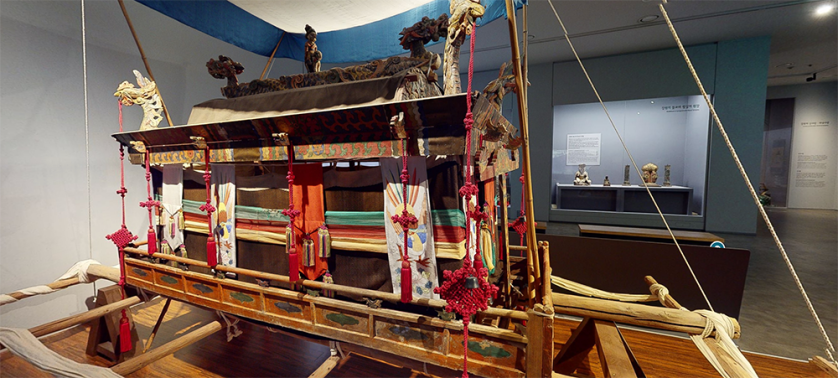
Also, you should understand the splendid, and even gorgeous carrier called  상여 (Sang-yeo) used to move died person from the funeral festival place to  the grave site called 장지 (Jangi).

This Sangyeo is currently located at Chuncheon National Museum

20-30 years ago, when I was a kid, there were a kind of 49, 100 or 150 times praying /ancestral rites to wish that person who died, go to a good place. In that case, every week, relatives gather at some place usually a temple, where sometimes, a monk danced to make a wish to return well together.    

I/my generation may be the last generation to see and attend this Korean culture.

Please visit the link if you want to see a monk dancing called Seungmu. 

Design a site like this with WordPress.com
Get started