[Wine Bits and Sips] The Charm of Wine

I share a series of Wine Bits and Sips, written by Junghyun. We invite you to start your wine journey right here, with us as your friendly guide, Junghyun.

for the original Korean version

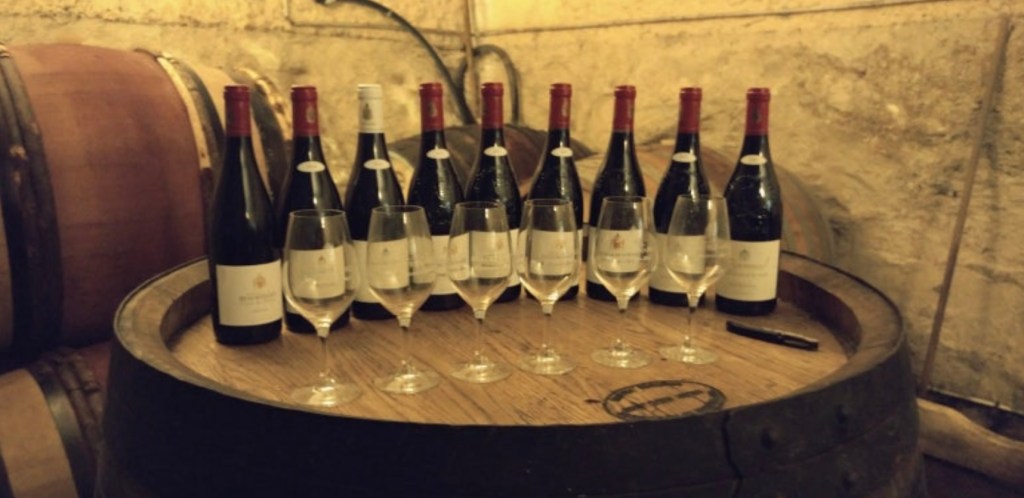
Winery of Chateauneuf du Paoe

Before we dive into wine cellars, ratings, and the age-old debate whether an expensive bottle is truly worth its price, let me tell you why I got into wine in the first place.

The beauty of wine, I think, is this: without packing a bag or going anywhere, you can sit still and travel the world through all five senses. That’s the charm, and sometimes, honestly, it can also be the headache. Choosing a wine can feel like a multiple-choice question with answer options that spill onto the next page. You can’t always get it right. But that’s exactly why the moment you stumble upon something extraordinary feels so electrifying. One unexpected sip can make your eyes go wide in wonder. When a wine truly delights you, even the long hunting for that perfect bottle becomes a kind of play. The risk is, of course, that if you fail too many times in a row, the motivation to keep trying quietly fades away. Along with it, you lose the chance of ever finding that one wine that brings you genuine happiness. This is why, rather than picking at random, it helps to improve your odds a little bit.

That’s what this series is about.

The usual advice is to begin your journey by finding a grape variety you enjoy.

Build a framework, something to anchor your choices so they’re easier to remember. In the New World, many wines are crafted from a single, well-known variety, which makes comparisons much easier. Mid-range American wines in particular tend to express their grape variety in a direct, straightforward way. Trying different bottles from the same producer, such as Long Barn or Textbook, across different varieties is a great way to map out your preferences. Textbook is best known for its reds and produces across a wide range, including Cabernet Sauvignon, Chardonnay, and Sauvignon Blanc, with Pinot Noir being a more recent addition to their lineup. Each grape brings its own skin thickness, natural sugars, and character, and you’ll taste these differences in the glass as distinct wine’s texture, tannins, acidity, and finishes. Once you discover a variety you love, you can begin expanding your horizons by seeking out the same grape from different countries. However, keep in mind that this is only one of many ways to explore the world of wine. 

Wine, they say, is a joint creation of the grape, the terroir, and the winemaker’s human hand. In France, it’s traditional not to list the grape variety on the label. Bordeaux-style blends are common, and the French tend to feel that variety alone doesn’t determine the wine’s soul. They see little reason to highlight it as the primary feature. During a Bordeaux winery tour years ago, where most of the guests were American. The winemaker poured a glass of deep, dark red wine and challenged us to guess the grape. Most guessed Cabernet Sauvignon or Syrah. The answer? 100% Merlot. These graphs came from vines nearly a hundred years old, rooted in the dry, stony soil of a hillside. While we were in Saint-Émilion on the Right Bank, an area where Merlot is the dominant variety and typically blended with small amounts of Cabernet Franc and Cabernet Sauvignon, that tasting was a revelation. It was the exact moment the concept of terroir finally clicked for me, instantly and completely.

I came to wine with a strong conviction that France was its spiritual home of wine, so I started there, tasting my way across the regions one glass at a time. Unlike the New World, France places terroir at the center of everything. I fell for the rich, brooding tannins of Bordeaux reds: that dark tropical fruit, the weight, and a seductive, perfume-like quality that lingers like a single drop of fragrance. A wine with real complexity doesn’t just speak to your palate. It speaks to your imagination. I’d find myself picturing an elegant woman in a field of wildflowers or something bold, dynamic, almost physical. That’s Bordeaux red to me.

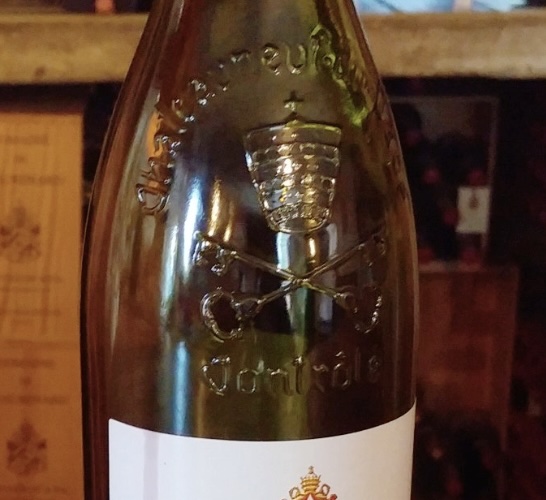
Chataeuneuf du pape bottle

Then came Châteauneuf-du-Pape (CDP), often called the Pope’s wine, hailing from the southern Rhône valley. During the Avignon Papacy, Pope John XXII built a summer residence and a winery north of Avignon, giving the region its name, which translates to the “new castle of the Pope.” While history suggests that the wines of the Rhône still required refinement at the time, leading the Pope to reportedly ship in Burgundy until local quality improved. One of the most striking features of these bottles is the embossed papal coat of arms, featuring the tiara over the keys of Saint Peter, which sets them apart from everything else on the shelf. CDP is a blend led by Grenache, Syrah, and Mourvèdre (GSM), along with other permitted varieties [the list has been revised from 13 down to 9 permitted varieties], which gives it a characteristic complexity. As a wine built for long aging, it possesses both power and elegance that never disappoints. Rich and full-bodied, yet more reasonably priced than Bordeaux or Burgundy, so it’s become my trusted bottle. It is a wine that feels particularly right from late autumn through the Christmas season, offering a warmth from the inside out. The only catch: it’s not exactly an everyday-priced bottle. Though when you see the vineyard, where every grape is hand-harvested and farmed organically, the price starts to feel entirely fair.

One afternoon at Lotte department store wine event, a staff recommendation led me to a Southern French Syrah

Most people associate Syrah with Australia, but it originated in France’s south. Phylloxera (a kind of aphid) devastated the vineyards of the region in the 19th century, and the Syrah planted today is technically a reimported variety; however, something about this land remains unchanged. The combination of limestone and gravel soils, paired with the fierce Mistral wind, gives Southern French Syrah a character entirely unlike its Australian counterpart. I drank a 2012 vintage in 2023 and was struck by the kind of balance and depth that only a well-aged, high-quality wine can offer. That specific wine is no longer imported, but whenever I spot a Syrah from the neighboring Roussillon region, it goes straight into my basket. Roussillon was long known for cheap table wine, but with talented winemakers moving in, the quality has surged, and you now find genuinely excellent value there.

When dining out, I often ask for a wine pairing recommendation, a habit that sometimes leads me to bottles I’d never have chosen for myself.

This is exactly what happened at a wine bar near my home. I typically did not reach for American wines, and when it comes to whites, I rarely stray beyond French Chardonnay, but this was wonderful, offering a rich, almost oily texture and ripe orange fruit, complemented by a touch of oak and just a whisper of mineral on the finish. It was quite simply delicious. Curious to see whether I could find a similar experience elsewhere, I tracked down a South African Chardonnay in the $20 range. South Africa occupies somewhere between the Old World and the New with a wine history that is much longer than most people realize. The Dutch East India Company planted vines there as early as 1662, producing the country’s first wine by 1669. By the 1880s, South Africa had become one of England’s premier wine suppliers until politics, natural disasters, and war pushed it into obscurity for decades. It was only under the presidency of Nelson Mandela that the wine industry began to rebuild. Today, South African winemakers draw from both traditions by studying Burgundian techniques while embracing the expressive, fruit-forward styles of the New World. The result is a collection of wines with a unique identity that often provide exceptional value.

Every new variety, region, and producer weaves together terroir, intention, and craftsmanship into a story that awakens all five senses. The world of wine is truly boundless.

This is how I travel the world, right from the glass on my dinner table.

Spring Flower Hyacinth

written by Younghee Lee, Essayist

for the original Korean version

Drawn by the warm sunlight, I stepped out into the yard and gently brushed aside the fallen persimmon leaves that had piled up since last autumn. As expected, beneath the leaves, pale green shoots and light purple flower buds were pushing their way up here and there. My heart, which had been shriveled during the long winter, filled with joy. I cleared away the leaves so the plants could receive more sunlight.

After Christmas and the year-end holidays pass, there are flowers that announce the arrival of spring first in my yard. It is the purple hyacinth. A long time ago, someone gifted me a pot of this plant. After enjoying its blooms, I planted the bulb under the persimmon tree. Since then, it has multiplied year after year, producing more flowers each spring. Like orchids, hyacinths grow green leaves on both sides, with a flower stalk rising from the center. Dozens of small blossoms cluster neatly along the stem, forming a single beautiful flower. Every morning, new stalks emerge, creating a feast of purple blooms, which is truly a breathtaking sight.

Looking up the meaning of the flower, I found that the hyacinth symbolizes “eternal love.” In Greek mythology, both Apollo, the sun god, and Zephyrus, the god of the west wind, fell in love with a young boy named Hyacinthus. The boy was exceptionally handsome, athletic, and even brave on the battlefield. Ultimately, Apollo and Hyacinthus became lovers.

One day, the two held a competition in a field to see who could throw a discus further. As Apollo caught a discus brilliantly thrown by Hyacinthus and hurled it high back toward him, Zephyrus – watching the scene in a fit of jealousy – blew a gust of wind. The wind caused the discus to strike the boy’s forehead, and he died. Clasping the boy in his arms, Apollo grieved. As he wept, he sprinkled the blood from the boy’s head onto the grass and promised to bring him back to life as a beautiful flower. Soon after, a flower bloomed from the blood-stained grass, and that flower is said to be the purple hyacinth.

Hyacinths carry different meanings depending on their color. Purple is eternal love and sorrowful love.  Red is love that lingers in the heart. Yellow is courage and win in love. Blue is the joy of love. White is peaceful love. Pink is playfulness and charm. While these expressions may seem distinct, all these meanings seem to represent the many emotions we experience when we love someone.

After the hyacinths fade, wood sorrel (Oxalis, called love plant in Korea), though never planted, spreads across the flower bed. Could it be the lingering traces of a love that didn’t fully blossom?

Then, the persimmon tree, jujube tree, and roses bloom in turn, completing the full arrival of spring in the yard. Watching this scene, I feel as though my own heart is blooming along with the flowers.

When spring arrives, flowers, grass, and trees do their absolute best to sprout and bloom. In doing so, they capture people’s attention and receive their love. They don’t even require much: a drink of water every few days and a few grains of fertilizer whenever they come to mind. Often, I don’t give them any fertilizer at all throughout the year. Still, as if keeping a promise, they bring us joy every day with a different appearance each time spring returns. Shouldn’t we also repay someone for the joy and beauty that nature gives us? Shouldn’t we, like the flowers and trees in our garden, sprout and bloom for someone else? It isn’t that difficult. It can be as simple as giving a bright greeting like a flower, yielding your spot in the checkout line at the market to someone with fewer items, not comparing yourself to others, avoiding greed, and not looking down on those around you.

Just as blooming a flower doesn’t require any extraordinary nutrients, we too can achieve this with just a little bit of effort. We are living in the age of AI (Artificial Intelligence), but I don’t believe we should live by relying solely on computers instead of people. No matter how beautifully a computer creates a flower, it is not a “real” flower. No matter how well an AI robot is made, how could it ever be the same as a human? Even the most wicked person has tears, don’t they?

There are times when we must not simply rush forward. If there is a terrifying cliff ahead and you keep running, you might fall and meet with disaster. Looking at a world where AI dominates every field, I am reminded of the 18th-century French Enlightenment thinker Jean-Jacques Rousseau. He argued that the excessive development of civilization, science, and art makes humans dangerous, corrupts them, and causes inequality. This is a theory worth reflecting on once again. For seniors like us, who must gradually slow down, the arrival of an era driven by artificial intelligence feels somewhat worrying.

I believe Rousseau’s famous words, Return to Nature,” serve as a warning to us. It is a cry to recover the inherent purity, autonomy, and moral intuition of humanity. I fear that “evil robots” might emerge and harm mankind. We humans have a duty to protect this Earth. God gave us this “Garden of Eden” called Earth in the vast universe. Just as every flower has its own unique characteristics, we humans must also exercise our individuality and traits to create a beautiful paradise.

A Christian Funeral


written by Younghee Lee, Oct 30 2025

For the Korean version

A few days ago, my husband and I attended the funeral of someone we barely knew, the wife of a friend of my husband’s. 

I had met her only once before, more than ten years ago, at her father’s funeral. She was the eldest daughter-in-law. After the service, several of my husband’s classmates gathered with their spouses, but she did not greet us. Instead, she stood apart, speaking eagerly with someone else. None of us got over to greet her as well. It was unusual, and I’ve remembered it ever since. 

I hoped to tell my husband to go by himself, but the funeral hall was some distance away from us, and my husband was not young, and we decided to attend together since the bereaved husband had personally sent the notice, and we felt it was right to go.

At the entrance to the funeral hall, we met the deceased’s husband. He looked worn and solemn, dressed in a white mourning suit. We exchanged greetings quietly, offered our condolences, and took a seat inside where the casket was placed. 

The portrait of the deceased—gentle and faintly smiling—was displayed on either side of the altar. That image was completely different from how I vaguely remembered her. She appeared warmer and more serene than I remembered. We met two of my husband’s classmates and sat together with the classmate who had come alone. 

The service began under the guidance of the deceased’s nephew, a pastor.  Prayers were offered and hymns were sung, following the order of service, and three of her four children shared brief memories of their mother. Only the youngest son spoke at length, sharing about his mother and her faith.

Next came the tributes from friends, many of whom were medical doctors like her husband. One man, visibly unwell, spoke while remaining seated. In a steady but solemn voice, he said, “None of us came here today for the deceased or for her family. We came for ourselves. No matter how faithfully one attends church, unless one is born again, one cannot enter the Kingdom of Heaven.” He quoted John 3, the words of Jesus to Nicodemus about spiritual rebirth.  It was continued. Someday, the deceased came and asked, “Were you reborn? While he just does and lives good habits with his mother’s religion. First her question startled him, and he even felt offended and uncomfortable, but the remark of the deceased allowed him to look back and experience the rebirth and still live with the rebirthed religious faith. Soon, the atmosphere became solemn as everyone reflected on themselves. 

Next it was the deceased’s husband’s turn. He spoke of how they met—how she had come to America and devoted herself to raising their four children and supporting him. His voice trembled as he recalled those early years. 

Fresh out of medical school, he was drafted and assigned a pressure sore patient, but he had never had any operation before. He continued that, unable to decline in front of his subordinates, he mustered the courage to proceed with the surgery, and thanks to the use of U.S.-made (Mijae), Mycin, the patient fortunately made a full recovery. At that time, the corpse used U.S.-made medication. The word “Mijae” caused a burst of laughter.  When we were young, the U.S. products were the best. The word that he succeeded in treating that patient spread widely, and even the community school’s principal visited, and that’s how he eventually met his wife. Standing before her, he reminisced about their youthful days.  A quiet ripple of warmth moved through the room. 

He planned to tell five grateful memories about her, but due to time constraints, he only shared three. How could it be only three? Even the fact that, in her youth, she declined a position as a KBS announcer and chose instead to serve as an announcer for Far East Broadcasting in Korea was itself a testament to the death of her faith. 

When he spoke about his wife, he said that memories came flooding out one after another, like sweet potato stems trailing in a row, and once again the funeral hall erupted in laughter. It was a heartwarming funeral.

The deceased, who passed away at the age of 85, wore the same serene smile from the very beginning, as if satisfied, displayed on both the upper corners of the frontal portrait. As the service drew to a close, the daughters continued to weep with the unmistakable grief of forever bidding farewell to their mother.

The words of Ecclesiastes 7:1-4 came to mind: A good name is better than precious ointment, and the day of death better than the day of birth. It is better to go to a house of mourning than to go to a house of feasting, for death is the destiny of everyone; the living should take this to heart. Frustration is better than laughter, because a sad face is good for the heart. The heart of the wise is in the house of mourning, but the heart of fools is in the house of pleasure. 

Most of those present were Christians, yet beyond doctrine, there was a shared understanding, an awareness that life does not end here, and that one must prepare for what lies beyond. 

The essential truth is that before death, no one is exempt. On this autumn day, with the sky so high, I felt I had glimpsed an answer to how I ought to live the remaining time of my life. All the way home, the hymn sung by the deceased’s sister and family, There, in that place, with the Lord, we shall live forever echoed in my ears.

Looking Back on 2024 and 2025, and Still Dreaming of a New Start

When my most recent biotech workplace shut down, I found myself at a crossroads. I still had the energy to dream of building a biotech startup, but after watching two companies I worked for shut down, I couldn’t even convince myself it would succeed.

So, instead, I took a different path. I enrolled in a free nursing course, a CNA program near my home, because I wanted to learn how I could continue helping others. That choice took me back in time to 1997–1998, when I worked with my college seniors in the psychology therapy club Torch Band and visited juvenile detention centers and psychiatric hospitals. Later, in 2008, I also learned about sandplay therapy. Those memories resurfaced as I began my new journey in nursing. After receiving my CNA certification, I worked at a nearby memory center while also preparing for pre-nursing courses. Since my previous college studies hadn’t included all the required U.S. nursing prerequisites. For example, I had taken animal physiology but not human physiology, so I needed to fill such gaps. At the memory care where I worked for a while, I noticed that quite a few seniors struggling with memory loss also had glaucoma. I can’t say that’s scientifically proven. I just noticed that some studies failed to show significant statistics on the connection. Someday, if I have the time, I’d love to dig into Korea’s public medical insurance datasets and explore the common mechanisms behind these conditions in more detail. What made me truly happy was seeing positive changes in the seniors with memory problems I cared for.

Maybe my interest in nursing was also influenced by my first daughter. In high school, she joined a medical club, and before college, she even took part in a high school internship program at Scripps Hospital. Later, even after choosing computer science as her major at UC Davis, she pursued EMT training. But in the summer of 2025, both of us stepped away. I quit my role as a care manager, and she stopped EMT training. That early summer, she was struck by a virus and diagnosed with meningitis. For nearly a month, her life was at risk, and I stayed by her side, helping her fight to survive. It brought back memories of my own hospitalization, when I spent a month with a high fever and no diagnosis. I still remember that near-death moment. Even in that split second, the experience remains etched vividly in my mind.

Even now, I still want to learn more about clinical care, but at the age of 50, it feels too late, less enjoyable, and not quite aligned with my current situation. While taking some pre-nursing courses, I also began exploring computer-related courses online and still hope to keep learning new things. My dream of starting a biotech company inspired me to explore publishing ventures, try self-publishing, and eventually start a nonprofit with my younger daughter. She is actually the founder and guiding force behind the BunnyPals Foundation. BunnyPals started as a small club for kids who had bunnies, but now it has grown to include writing and craft clubs, as well as Korean language learning. I hope to help children nurture creativity, compassion, and environmental awareness through artistic expression, storytelling, and community engagement. I also dream of helping them become authors of their own creative works.

Part of me still dreams of returning to research or building a research-focused nonprofit or startup. I wait for that dream. 

Looking back, my life has been a journey of choices. Some I treasure, some I wonder about. For example, I once had the chance to pursue medical school or clinical psychology, but I didn’t. Do I regret it a little? Yes. But deep down, I know that even if I could go back, I might still choose this same path.

As an undergraduate in Korea, I never knew clinicians could also be researchers. I simply wanted to discover something new and contribute to patients’ well-being as a scientist. Also, I know if I chose a different path, I would have never researched. Now, though, I believe that for most people, education and lifestyle changes should come before medication.

To my juniors, including my daughters, I hope you’ll always find the resources you need for your career paths and that you’ll follow not just ambition but also your heart. May you always be wise enough to find balance between life, work, and money.

GoJoseon—The first kingdom in Korea

Records about Gojoseon are found in the book Samguk Yusa (written by Buddhist monk Iryeon), which says that it was founded in 2333 BCE by Dangun Wanggeom.

According to the Dangun myth, Hwanung (a heavenly being who descended to earth) had a son named Dangun with Ungnyeo (a bear who transformed into a woman). The country that Dangun established was called Joseon.
Later in history, another kingdom called Joseon appeared, as you know, so historians use the name Gojoseon (“Old Joseon”) to refer to the earlier kingdom. Chinese historical texts such as the Shan Hai Jing and Guanzi also mention Joseon.

Gojoseon was based on a Bronze Age culture but broadly seems to cover the late Neolithic and early Iron Age and was said to have the Law of Eight Prohibitions. Among them, three laws are still passed down and known:

  1. A person who commits murder shall be executed.
  2. A person who injures another must compensate with grain.
  3. A person who steals shall become a slave. To redeem themselves, they must pay a fine of 500,000 coins.

It is believed that Gojoseon’s territory may have reached as far south as present-day Seoul.

In Korea, many dolmens (ancient stone tombs, Goindol in the Korean pronunciation) can still be found throughout the Korean Peninsula.


If you want to see a representative example, you can visit LegoLand in Chuncheon, South Korea, where such remains as Neolithic pit houses and Goindols scattered. In fact, it is known that the land beneath LegoLand contained many archaeological things, and the construction of the park was heavily opposed. Despite this, LegoLand was eventually built on the site.

 You can check it out on this website! But the information is written in Korean.


There is one Korean drama, Tae Wong Sa Shin Gi based on the Gojoseon legend.

Unfortunately, there are still no officially English-dubbed versions. JustWatch and Netflix only provide non-English versions.

There is some OST series of Tae Wong Sa Shin Gi on YouTube.

and….

I found Ep2 (Eng Sub) of Tae Wong Sa Shin Gi on YouTube

Hobbies should be purely for enjoyment.

written by Younghee Lee, July 2025

painted by Younghee Lee

Google tells me that a “hobby” is an activity done for pleasure, while a “special skill” is a talent or ability in which one excels beyond others. Over the years, I’ve come to understand how differently these two can be experienced in life.

When our children grew up and left the nest, the house felt unbearably quiet with just my husband and me. The days stretched long, and I wondered how to fill the hours. Then, one day, the thought came to me—I should paint.


Perhaps it was because, as a child, I never had proper art supplies and never dared to try. Without hesitation, I bought watercolor paints, brushes, a sketchbook, and even an easel. The joy and anticipation of that moment still feel vivid to me.

The first thing I painted was the red begonias blooming on our balcony. It was a clumsy piece, with no regard for light, shadow, or perspective, but leaning it against the living room wall filled my heart with happiness. Guests would compliment it and ask, “Who painted this?” I would reply, “I started it as a hobby—it’s my first since elementary school.” My memories of school art classes were purely theoretical; all I felt now was the pride of beginning something new.

After we moved to the United States, I often took my granddaughter to her art class. Watching her made me want to learn again. I gathered my courage, asked her teacher, and was warmly welcomed. I signed up for weekly lessons, walking home with my heart brimming with excitement. This time, I truly believed I could paint “real” paintings.

Reality, however, was humbling. I remembered how my high school aptitude test had shown a dismal score in spatial perception. My math and logic were near perfect, but my spatial awareness—a key to artistic ability—barely reached eighty points. Painting, it seemed, was not my natural gift. When I traveled, I was always tempted to capture beautiful scenes on canvas rather than in photographs, but that longing often turned into pressure.

Thankfully, my children loved my work, no matter how imperfect. Whether I painted roses that looked like smudges, sunflowers that resembled wildflowers, or adults that looked like children, they said, “We love it because it’s Mom’s painting.” To my surprise, my American son-in-law’s parents—who both majored in art—hung my painting of geraniums in their kitchen, calling it “fresh in a way only amateur work can be.”

Last year, my tenth-grade grandson lived with us. Gifted in sports, he had transferred from San Francisco to Los Angeles to improve his skills. In a family where academics had always been the priority, his decision surprised us. At first, we thought it was just a passing phase, but we were wrong. He threw himself entirely into school and club activities and even managed his diet with discipline, avoiding anything unhealthy. For him, his hobby and his special skill were one and the same—and his joy in doing it brought exceptional results.

Now, my grandson has returned home, and I am back to my own routine. The first thing I want to do is paint again. I’ve taken such a long break that it feels daunting, but I’m determined not to put down my brush. My sister, who knows me well, often asks why I struggle with painting instead of focusing on something I’m good at. My answer is simple: because it makes me happy. And I intend never to forget that a hobby should be pursued purely for the joy it brings.

For this Korean Version

The oldest lyric poem

Today, I looked into the oldest existing poem in the world.


Although it is uncertain whether Gongmudohaga is the oldest poem in the world, it is certainly the oldest existing lyric poem.

Upon research, similar poems from roughly the same period (estimated 1st to 2nd century BCE) exist in Sumerian, Indian, and ancient Egyptian civilizations.
Notable examples include the Epic of Gilgamesh (Sumerian civilization), Ligurra’s Hymns (Sumerian civilization), pyramid tomb wall inscriptions (ancient Egypt), and the Rigveda (India).

Gongmudohaga, the oldest poem in the world, is estimated to be from the Late Gojoseon or early Goguryeo period, around the 2nd to 1st century BCE.

Original text of Gongmudohaga and Korean pronunciation

This poem is recorded in historical texts such as Haedong Yeoksa, Daedong Siseon, Cheonggu Sicho, Yeonamjip, and Samguk Yusa. Samguk Yusa was fully translated into English as the book titled Overlooked Historical Records of the Three Korean Kingdoms in 2006.

Content of Gongmudohaga (translated)

The author is unknown but traditionally believed to be the wife of Baek Sugwangbu or Yeok, the wife of Gwak Rijago, who helped preserve the song as a poem.

It is said that the poem was sung/shouted when a woman witnessed her husband drown while crossing a river and sang/cried this lament, which was then recorded and passed down as a song.

Design a site like this with WordPress.com
Get started