
시간
2025/10/29 김수영 씀
할 일이
많아도
할 일이
적어도
보내는
시간은 같다
정작 무엇이
바람직한것인지는
알 수 없다!!
Time
Whether there’s a lot to do
or very little to do,
we spent the same time.
I don’t really know
what the ideal situation is!
Little or much to do.
인생, 차강석 씀 | Life by Cha, KangSeok
인생
2026/01/16 차강석 씀
창 밖에는
눈이 마구잡이로
내린다
종교를 갖기에는
내 정신이
너무 맑은 것 같다
가족을 갖고 싶지만,
너무 늦어 버렸다
오랜 친구들도 없어서
가슴앓이를 얘기할
지인도 없다
여생을 함께 할 사람이 없어
혹독한 삶이 될 것이다
언젠가는 지워질 눈밭에
발자국을 새기며 걸어가야겠다
Life
Beyond the window
snow falls
without mercy
To take up religion,
my mind is
too clear
I want a family,
but the time
has passed
I have no old friends
to speak my quiet grief to
With no one
to share what remains,
life will be a severe road
However, I will walk,
leaving my footprints behind
on a field of snow,
that will someday be erased.
따뜻한 추위, 차강석 씀 | Warm Cold, by Cha, Kang Seok
따뜻한 추위
2026/01/09 차강석 씀
갓난아기의 볼은
시베리아에서도 늘 따뜻해야 하듯
우리 사회의 온도도 그러해야 합니다
추위 속에서 고생한 누이가
장난으로 동생의 품속을 파고들어
서로의 온기를 나누듯 우리도 그럽시다
우리가 체온을 서로 나눌 때
북극의 한파가 봄바람으로 변하듯
혹독한 추위가 따뜻한 추위로 변할 것입니다
Warm Cold
Jan 9, 2026, written by Cha, Kang Seok
Just as a newborn baby’s cheeks
must always be warm, even in Siberia,
the temperature of our society should be.
Like a sister who,
having suffered in the cold,
playfully burrows into her younger sibling’s embrace
to share their warmth,
let us do the same.
When we share our body heat with one another,
Even the arctic chill will transform into a spring breeze.
The harsh cold becomes a warm cold.
(Book extract) The Three Ordinary Voices of God – continue 002
by Matthew Kelly
This is the second reading of this book, and I share some, and it will be continued.
The book starts with listening to God and asks us whether we are mis-living our lives or not: What does it mean to mis-live your life? It means to lead a life marked by water potential and misaligned with all that is good, true, just, and noble. I’ll say it again: you can mis-live your life. Have you ever mis-lived an hour? The problem is, put enough of those mis-lived days together and you will find yourself on the wrong side of a life well-lived. How do you find your way back from mis-lived days, weeks, or even years? It is simple but not easy. It is done one choice at a time. Begin now, without delay. Rectify your life immediately. A well-lived life is built the same way a mis-lived life is built: one choice at a time. Every choice builds character or erodes character. Making your next choice can shift the momentum of your day.
Make your next choice one that belongs in a well-lived life.
(Book) The Three Ordinary Voices of God
written by Matthew Kelly
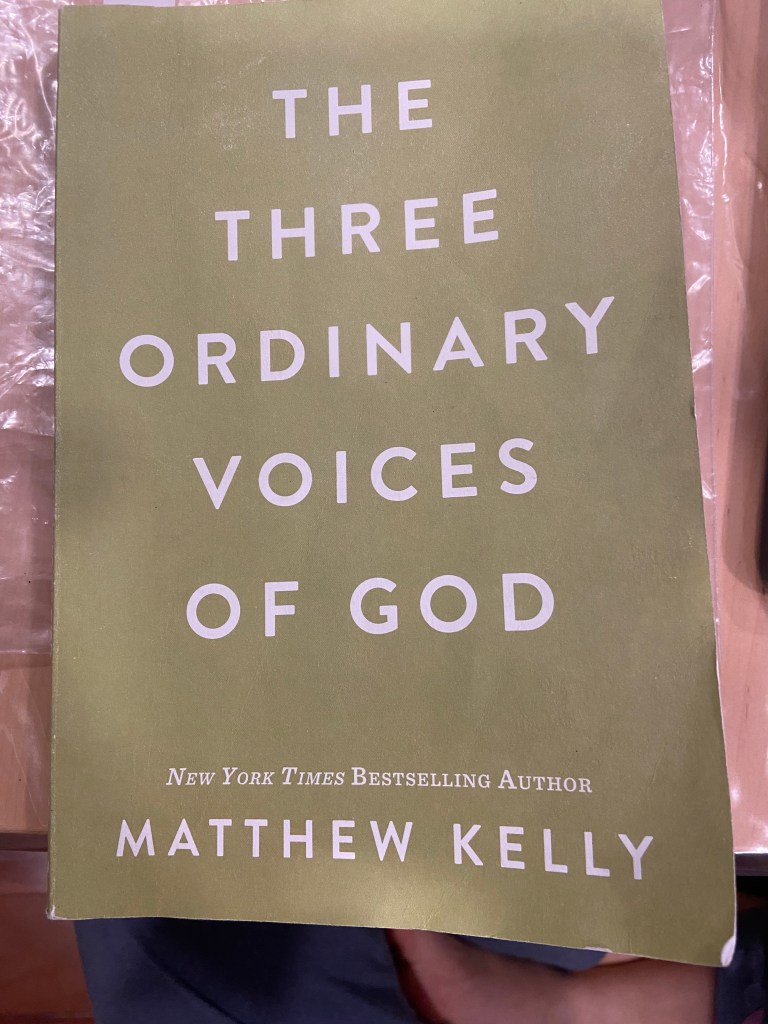
I started reading the book after I found it in a pile of books that others had left near the escalator of the condominium where I live. The book was too good to rush through, so I read one section a day and eventually finished it.
Chapters are followings:
Let your life speak for itself
The first voice: Needs
The second voice: Talent
The third voice: desires
The ultimate desire
Come to the quiet
The book opens with this:
Listening to God is an act of hopeful expectation
Listening to God requires an open heart
Listening to God requires us to set aside our personal preferences and agendas
Listening to God involves letting go of our stubborn
And prideful desire to do whatever we want
Listening to God requires humility
Listening to God is an act of surrender
Will you listen?
I do not extract line by line because I hope to move all sentences, so I recommend you read the book or If you Google the author’s name, Matthew Kelly, you can find his YouTube Channel
(Book Extract) Together is Better
written by Simon Sinek, bestselling author of Start with Why and Leaders Eat Last
Today in the morning, we, our family, read some part of the Bible, Ecclesiastes 5:9 to 12.
Two are better than one, because they have a good return for their work: if one falls down, his friend can help him up. But pity the man who falls and has no one to help him up! Also, if two lie down together, they will keep warm. But how can one keep warm alone?
This afternoon, when we visited a library, I found a small book titled “Together is Better.” What a coincidence. However, this book was about leadership rather than how to live.
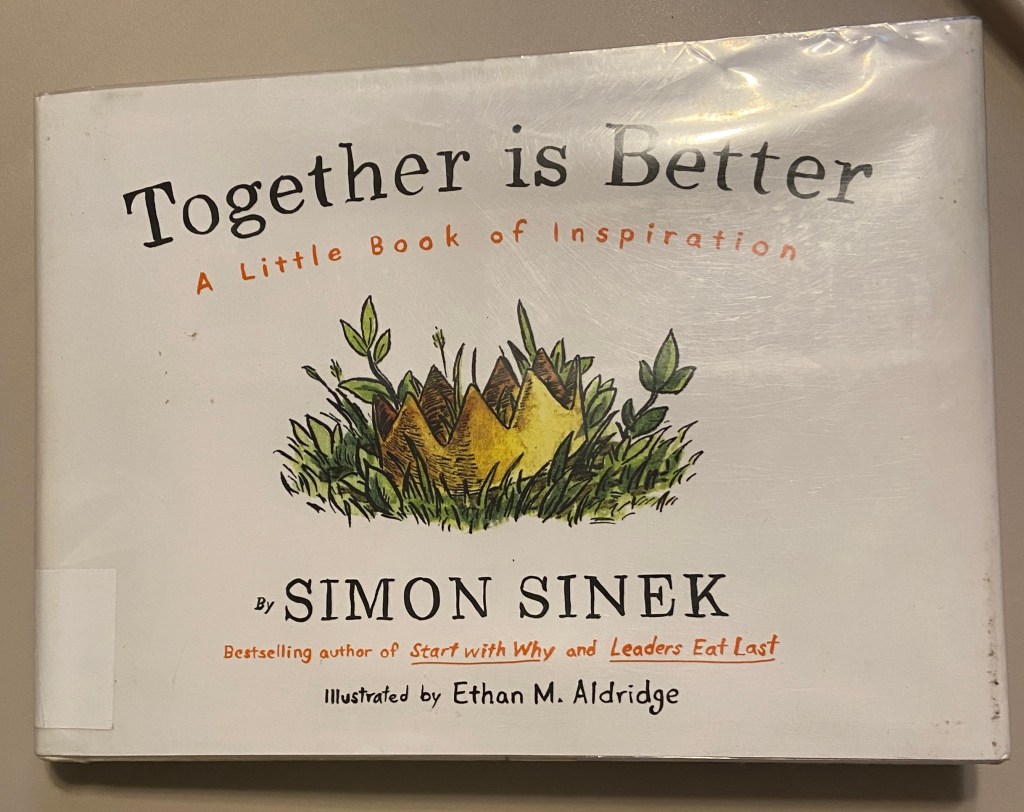
I introduce some parts from the book here:
Most of us live our lives by accident—we live as it happens. Fulfillment comes when we live our lives on purpose.
With good leaders, we feel like we work for each other.
To create change that lasts, we need to know what we stand for.
Do something big or small. But stop wondering and go on an adventure
Stop talking about it and do it
Impact comes from action
All that matters is that we start
Wake up, drink your passion, light a match, and get to work
Life requires risk if we are to get anywhere
When we say out loud what we don’t know, it increases the likelihood that someone who does know will offer help.
Innovators are the ones whose dreams are clearer than the reality that tells them they are crazy
The best way to find out if it will work is to do it.
Always plan for the fact that no plan ever goes according to plan
If the challenge we face doesn’t scare us, then it’s probably not that important
When we are open to criticism, what we get is advice
Bad leaders care about who’s right
Good leaders care about what’s right
Don’t complain, contribute
You can’t do it alone, so don’t pretend you can
A team is not a group who work together
A team is a group of people who trust each other
A great leader inspires us to have confidence in what we can do
The opportunity is not to discover the perfect company for ourselves. The opportunity is to build the perfect company for each other.
It is an honor to put the interests of others before ourselves
Our struggles are the short-term steps we must take on our way to long-term success
Failure we can do alone. Success always takes help.
A boss has the title. A leader has the people.
The true value of a leader is not measured by the work they do. The true value of a leader is measured by the work they inspire others to do.
Working hard for something we don’t care about is called stress. Working hard for something we loves is called passion.
To go fast, go alone. To go far, go together – African proverb
Excitement comes from the achievement. Fulfillment comes from the journey that got you there.
산, 차강석 씀 | Mountain by Cha, KangSeok
산
2025/11/21 차강석 씀
백두산이 백록담을
품고 장엄하게 우뚝 솓아 있다
어두운 숲은
사람들의 발걸음을 허락하지 않는다
어두워서 신비한 숲은
사람들을 거부하고 오묘함을 간직한다
백련산이 백련사를
안고 복스럽게 푹 앉아 있다
성글성글한 숲은
약수터에 사람들로 붐볐다
급기야.
굴삭기에 점령 당했다
언덕으로 전락한 백련산은
아파트와 함께 사람들과 어울린다
이상은 백두산이지만
현실은 백련산……
Mountain
Mountain Baekdu standsmajestically, embracing Baekrokdam.
The dark forest
does not permit human footsteps.
The dark and mysterious forest
preserves its mystery without people.
Mountain Baekryeon sits
blissfully, embracing Baekryeon Temple.
The lush forest became crowded
with people at the spring.
Eventually,it was taken
over by an excavator.
Mountain Baekryeon became to a hill mingles
with people alongside apartment buildings.
Mountain Baekdu is ideal
but the reality is Mountain Baekryeon

