
GoJoseon—The first kingdom in Korea

Records about Gojoseon are found in the book Samguk Yusa (written by Buddhist monk Iryeon), which says that it was founded in 2333 BCE by Dangun Wanggeom.

According to the Dangun myth, Hwanung (a heavenly being who descended to earth) had a son named Dangun with Ungnyeo (a bear who transformed into a woman). The country that Dangun established was called Joseon.
Later in history, another kingdom called Joseon appeared, as you know, so historians use the name Gojoseon (“Old Joseon”) to refer to the earlier kingdom. Chinese historical texts such as the Shan Hai Jing and Guanzi also mention Joseon.

Gojoseon was based on a Bronze Age culture but broadly seems to cover the late Neolithic and early Iron Age and was said to have the Law of Eight Prohibitions. Among them, three laws are still passed down and known:

  1. A person who commits murder shall be executed.
  2. A person who injures another must compensate with grain.
  3. A person who steals shall become a slave. To redeem themselves, they must pay a fine of 500,000 coins.

It is believed that Gojoseon’s territory may have reached as far south as present-day Seoul.

In Korea, many dolmens (ancient stone tombs, Goindol in the Korean pronunciation) can still be found throughout the Korean Peninsula.


If you want to see a representative example, you can visit LegoLand in Chuncheon, South Korea, where such remains as Neolithic pit houses and Goindols scattered. In fact, it is known that the land beneath LegoLand contained many archaeological things, and the construction of the park was heavily opposed. Despite this, LegoLand was eventually built on the site.

 You can check it out on this website! But the information is written in Korean.


There is one Korean drama, Tae Wong Sa Shin Gi based on the Gojoseon legend.

Unfortunately, there are still no officially English-dubbed versions. JustWatch and Netflix only provide non-English versions.

There is some OST series of Tae Wong Sa Shin Gi on YouTube.

and….

I found Ep2 (Eng Sub) of Tae Wong Sa Shin Gi on YouTube
The oldest lyric poem

Today, I looked into the oldest existing poem in the world.


Although it is uncertain whether Gongmudohaga is the oldest poem in the world, it is certainly the oldest existing lyric poem.

Upon research, similar poems from roughly the same period (estimated 1st to 2nd century BCE) exist in Sumerian, Indian, and ancient Egyptian civilizations.
Notable examples include the Epic of Gilgamesh (Sumerian civilization), Ligurra’s Hymns (Sumerian civilization), pyramid tomb wall inscriptions (ancient Egypt), and the Rigveda (India).

Gongmudohaga, the oldest poem in the world, is estimated to be from the Late Gojoseon or early Goguryeo period, around the 2nd to 1st century BCE.

Original text of Gongmudohaga and Korean pronunciation

This poem is recorded in historical texts such as Haedong Yeoksa, Daedong Siseon, Cheonggu Sicho, Yeonamjip, and Samguk Yusa. Samguk Yusa was fully translated into English as the book titled Overlooked Historical Records of the Three Korean Kingdoms in 2006.

Content of Gongmudohaga (translated)

The author is unknown but traditionally believed to be the wife of Baek Sugwangbu or Yeok, the wife of Gwak Rijago, who helped preserve the song as a poem.

It is said that the poem was sung/shouted when a woman witnessed her husband drown while crossing a river and sang/cried this lament, which was then recorded and passed down as a song.

Korean Movie, Festival, 1996

Full movie: clink here

Today, I hope to mention cultural differences in death in Korea and the US. I do not say there are differences between Asia and Western because I do not want to generalize too much, and I do not know about any other countries. 

There were several differences between funerals in Korea when I was young and Western funerals, but currently, many Koreans have started following the Western style and/or mixed form of them.

To understand funerals and deaths in Korea, 

Maybe we should mention the Korean word, 돌아가다 (Die), our Korean word of 돌아가다 (Die) means also “Return”.

So Dying is Returning to original home place, and usually, funeral is a bigger festival than any other souvenir days such as birth and wedding.

In the movie, you could see white Korean dress and a white ribbon hair pin, which relatives and related people wear when someone dies. 

Whereas  the Westerners wear black. 

And the person who died, wore hemp clothes. Hemp is one of the best clothes that returns to the dust and returns to nature. 

Sometimes, the elderly and seniors in Korea prepare their own hemp before dying.

Also, direct children, usually men, also wear hemp clothes.  

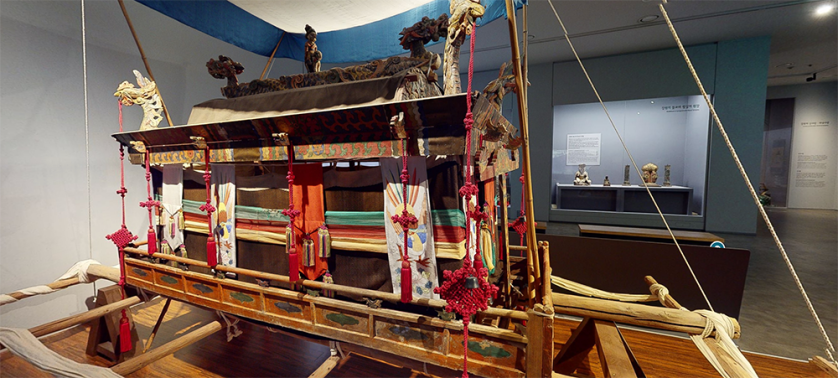
Also, you should understand the splendid, and even gorgeous carrier called  상여 (Sang-yeo) used to move died person from the funeral festival place to  the grave site called 장지 (Jangi).

This Sangyeo is currently located at Chuncheon National Museum

20-30 years ago, when I was a kid, there were a kind of 49, 100 or 150 times praying /ancestral rites to wish that person who died, go to a good place. In that case, every week, relatives gather at some place usually a temple, where sometimes, a monk danced to make a wish to return well together.    

I/my generation may be the last generation to see and attend this Korean culture.

Please visit the link if you want to see a monk dancing called Seungmu. 

Design a site like this with WordPress.com
Get started