
AAV Serotypes for Intravenous Gene Therapy (1)

Today, I wrote a bit about AAV serotypes and doses, and target organs, inspired after reading Reporter’s notebook 

CAP-002 case

clinical fatalities and the limits of IV-delivery

A child died in Capsida’s CAP-002 trial in September 2025,  the first patient treated with an engineered, IV-administered, BBB-crossing AAV for STXBP1 encephalopathy. 

Capsida Biotherapeutics voluntarily halted the SYNRGY trial (NCT06983158) after the first treated paediatric patient with developmental and epileptic encephalopathy (DEE) caused by STXBP1 mutations, died. The cause of death remains under investigation. CAP-002 is notable because its capsid was specifically engineered to cross the blood-brain barrier (BBB) via IV infusion, without intracranial injection. Regulators did not enforce the hold. However, Capsida self-imposed it while searching for the root cause.👍


Now, we should check some adverse events linked to IV AAVs. 

Reported patient deaths linked to IV AAV by serotype
SerotypeDrug / companyIndicationCause of deathStatus
AAV9Zolgensma (Novartis)Spinal muscular atrophy (SMA)Acute liver failure (ALF)2 deaths, 2022 (Zhang et al.)
AAV9Multiple high-dose trialsVarious CNS / neuromuscularThrombotic microangiopathy (TMA)Multiple cases (Zhang et al.)
AAV9 (NGN-40)NeurogeneRett syndromeRare hyperinflammatory syndrome1 deathPhase I/II (Joshua Silverwood)
AAV9-based (RP-A501)Rocket PharmaceuticalsDanon diseaseFatal acute systemic infection1 death, Phase II (Annabel Kartal Allen)
AAV8ASPIRO trial (AT132)X-linked myotubular myopathy (XLMM)Cholestatic liver failure4 deathsPhase I/II (Shieh et al.)
AAVrh74Elevidys (Sarepta)Duchenne muscular dystrophyAcute liver failure3 deaths (Annabel Kartal Allen)
Engineered AAV (CAP-002)Capsida BiotherapeuticsSTXBP1 encephalopathyUnknown — under investigation1 death, Sept 2025 (Annabel Kartal Allen)

What the AAV5 story teaches us

Now, we have to think about AAV5’s successful story. A decade of relative safety, why?

In August 2022, Europe approved the world’s first AAV5-based gene therapy for severe hemophilia A – Roctavian (valoctocogene roxaparvovec), developed by BioMarin. The FDA followed in June 2023. Since Phase 1/2 trials began in the mid-2010s, hundreds of patients have received a single IV infusion of AAV5, and to date, no patient deaths have been directly attributed to the therapy. In a field where other AAV programs have seen multiple fatalities, this is a notable record.

Hemophilia A is caused by a missing clotting protein (Factor VIII) that is normally made in the liver. So the therapeutic goal of Roctavian is simply to deliver a working gene to liver cells  and the liver happens to be exactly where AAV naturally travels after an IV injection. The vector does not need to fight its way past any biological barriers. It goes where it was always going to go.

So what makes AAV5 different? The answer is not the stereotype itself [I think, and some others would agree with me although it is some part of stories].  


The dose matters. 

Because the liver is the natural destination for IV-delivered AAV5-based gene therapies, a relatively modest dose is enough to achieve a therapeutic effect in hemophilia. Roctavian is given at 4–6 × 10¹³ vg/kg, roughly half to a third of the doses used in CNS or muscle-targeting programs. That difference in dose is, in large part, the difference between a therapy with an acceptable safety profile and one that has killed patients.

Why does the target organ change everything?

Think of it this way. When you give AAV through an IV, the vector enters the bloodstream and travels throughout the body. The liver acts like a sponge as always. It absorbs a large fraction of whatever AAV is circulating, regardless of where the doctor wants it to go. This is simply how our body works.

For hemophilia, this is actually favorable: you want the gene delivered to liver cells, and the liver is already soaking it up. A dose of 4–6 × 10¹³ vg/kg is enough to transduce enough liver cells to restore Factor VIII production. The liver handles this dose without triggering a dangerous immune response in most patients.

But for diseases of the brain or muscle, the liver is an obstacle, not a destination. To get enough AAV past the blood-brain barrier or into muscle tissue, you have to flood the entire system with a much larger dose, often 2 to 10 times higher. The liver still absorbs most of it, now overwhelmed by vectors it was never meant to receive in such quantities. The result, in the worst cases, is acute liver failure, immune storms, or vascular damage.

The safety record of AAV5 in hemophilia is genuinely encouraging, but it would be a mistake to conclude that AAV5 is simply a “safe” serotype. The real lesson is more specific and more important: IV gene therapy works best and most safely when the target organ is the liver. AAV5 has never been tested at the doses that CNS or muscle delivery would require, so we simply do not know how it would perform in that context.

What the full clinical picture tells us is that the moment gene therapy asks AAV to travel beyond the liver via IV, the dose requirements climb into a range where serious toxicity and death become real risks regardless of which serotype is used. AAV8, AAV9, and AAVrh74 have all produced fatal outcomes in this higher dose regime. Engineered capsids designed to cross the blood-brain barrier represent the field’s attempt to break this trade-off, but as the September 2025 death in Capsida’s trial shows, even the most advanced designed next-generation vectors carry unknowns that only human trials can reveal [The dose not disclosed yet]

A lower dose of IV gene therapy targeting other organs might be successful, which underscores the need for more efficient AAV engineering or local injection to resolve these matters.

Reference

Annabel Kartal Allen. “Child Dies in Phase I Capsida Gene Therapy Trial.” Child Dies in Phase I Capsida Gene Therapy Trial, Clinicaltrialsarena, 12 Sept. 2025″

Joshua Silverwood. “Patient Dies in Neurogene’s Phase I/II Rett Syndrome Trial.” Patient Dies in Neurogene’s Phase I/II Rett Syndrome Trial, Clinicaltrialsarena, 22 Nov. 2024″

Shieh, Perry B., et al. “Safety and Efficacy of Gene Replacement Therapy for X-Linked Myotubular Myopathy (ASPIRO): A Multinational, Open-Label, Dose-Escalation Trial.” The Lancet Neurology, vol. 22, no. 12, Dec. 2023, pp. 1125–39. DOI.org (Crossref)

Zhang, Wenwen, et al. “Comprehensive Analysis of Adverse Events Associated with Onasemnogene Abeparvovec (Zolgensma) in Spinal Muscular Atrophy Patients: Insights from FAERS Database.” Frontiers in Pharmacology, vol. 15, Jan. 2025, p. 1475884.

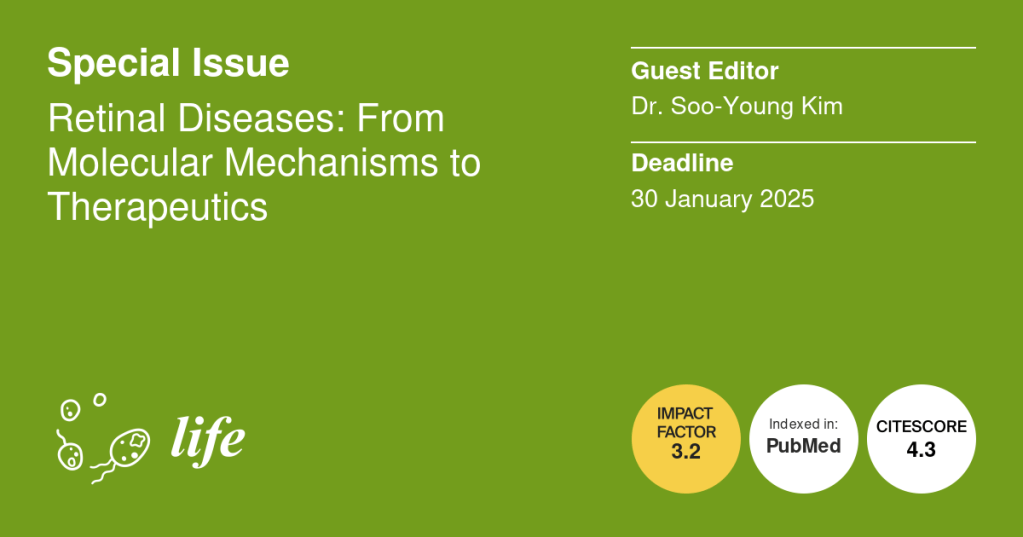
Special Issue Guest Editer, Life, MDPI

I have served as a guest editor at Life (ISSN 2075-1729) since my workplace shut down and I lost my job. My workplace, USA Research and Development Center of Neurophth Therapeutics Inc., had decided to close our team when they started aggressively the clinical trial and just before obtaining the Series-C investment. I believe that our early development team actively studied and supported the company’s Business portfolio until our center closed. We, our team built up one center, and we observed as well their closing. Building something up took more time than shutting it down. The closing was quite quicker than I expected.

I met MDPI when I published a review paper, Twenty Years of Anti-Vascular Endothelial Growh Factor Therapeutics in Neovascular Age-Related Macular Degeneration Treatment at the journal of International Journal of Molecular Sciences. I started studying age-related macular degeneration in 2011, when I examined the retina of an aryl hydrocarbon receptor (AhR) knockout. Maybe any molecules in our body will have two sides of the balance– good and bad. Even vitamins and minerals are toxic when they are deficient and plenty. Especially, AhR was very interesting because it is one of important molecules for the balance of the immune system. I studied immunology for my master’s, because I thought that all diseases including brain and retina, had no exception from the immune system, after working as a BS research associate at the section of Neurodegenerative diseases, Korea National Institutes of Health, During mater degree program, I especially studied about NKT and non-classical major histocompatibility complex (MHC) molecule in the autoimmune diseases using molecular genetic engineering, animal and cell experiments. After that, I studied several adhesion molecules during brain development during my Ph.D program. My first publication of the first author was spatiotemporal expression patterns of non-clusteted protocadherin family members in the developing rat brain. I studied brain anatomy as well as brain primary neuronal culture with this project. When I came into the USA, I started basic research and translational studies using cells, engineered chemicals, nano-packed small molecules, peptides, antibodies, exosomes, and adeno-associated viruses in retina degenerating animal moldels. Sometimes, I developed new animal models and new analysis methods to test the candidate drugs. Some of them have been published. Many of them have not be published because some did not exhibit good enough efficiency, and some did show too good efficiency to be published ^.^. Actually, good efficiency is a really small piece and small step for the development in the view of company. Sometimes candidate drugs had enough good efficiency but the manufacturing was a hurdle, and some expected fancy drugs had toxicity, killing disease model animals. Synthetic nucleotide engineering was facinating to me, because somehow synthetic nucleotide engineering easily generates antibodies, antibody fragments, AAVs, fusion proteins, and any proteins, and nucleotide sequences could be all changed, and optimized to increase the yields of the proteins and still reduce the immune activation, which nobody knows the detailed profiles before testing them. Research and Development is a really initial step for drug development, but the tiny, tiny things of the early stage development could cause dramatic misfortune and a tragedy in patients’ safety.

To me, taking a role as a guest editor is an honor, and a chance to continue reading and following the field and learn a little other countries — China, Europe, and Eastern Asia, as well as Korea, where I was born, and the USA, where I’m. All the research situations were not the same, really based on the grant money, medical insurance, and the community acceptance based on different countries. While serving Life special edition as a guest editor, what I have learned so far is that we science communities should encourage us to share what we are studying in different countries, giving chances to collaborate and know and understand each other’s scientific environment and situation, and further science should give benefit, fun, hope, and new knowledge to the public.

One thing I have worried in the current science communities is…..

We, even our kids, like Youtube channels, and they check the number of their followers. This kind of behavior could be harmful to the basic scientific world. We scientists pursue grant trends, and check journal impact factors for their survival, but we scientists should remember their own questions, purpose, and fun. We adults, the senior old generation, should allow and help our young generation to pursue their own scientific questions and have trials and errors in our educational system, not only increasing publication records. I worry about our severely competitive academic world where the young generation has no chance for them to pursue their own questions, and not allow enough failure and early lost academic fun in pursuing their own questions.

In the end, I believe, that journals could or should help our science communities to make meaningful research, and promote sharing.

I accepted my role of a guest editor, Life, when I read the Aim and Scope of Life. At least I felt that Life is trying to serve a broad science and public communities, and communities’ questions, and scientific funs. However, I wondered why they decided on a similar journal name to elife: T.T.

If you want to visit Life, click here

If you want to vist the special issue of Retinal Diseases: From Molecular Mechanisms to Therapeutics, click here.

Thank you for reading!!

Design a site like this with WordPress.com
Get started